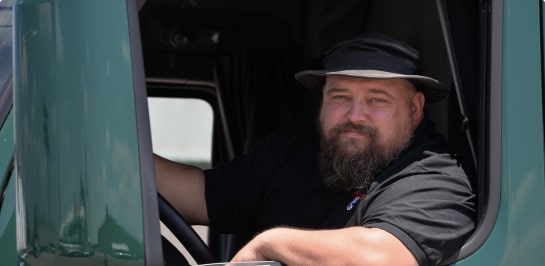
If there is one piece of technology that sparks more heated debate at the truck stop lunch counter than ELDs, it’s driver-facing cameras. Scroll through Reddit or The Truckers Report, and you’ll see the sentiment is almost universally hostile. When discussing inward-facing cameras in trucks, drivers often report feeling watched, nagged by AI voices, and that the privacy of their second home – the cab – is being violated. It’s a feeling of losing the last bit of freedom on the open road.
We hear you. And at HMD Trucking, we believe in shooting straight. So, let’s strip away the corporate buzzwords and look at the cold, hard reality of why dash cams are becoming the industry standard, and answer the ultimate question: Are they a spy, or are they your savior?
Contents:
The "Spy" Argument: We Get It
The “Big Brother” factor cannot be ignored. An OTR truck driver’s truck is not just a place to work, but a bedroom, kitchen, and living room. You might feel like you are being intrusively recorded when you are trying to relax or have a sandwich. Many drivers feel that the installation of driver-facing cameras in trucks represents a direct invasion of that private sanctuary. If your boss wouldn’t let you into the dining room at home, why not into the sleeping berth?
“AI Fatigue,” when systems yell at you to check a side mirror or take a sip of coffee. There is also the fear that this footage would simply be another way managers could micromanage their people. Even worse, this would serve as enough inspiration for self-driving trucks to replace truckers in the future. It is much harder to trust a trucking assistant who yells “Distracted!” for checking your GPS when he or she looks at it for a moment. We know that false alerts from sunlight or shadows can drive you crazy over a long shift.
But it is also worthwhile to learn how these systems function in reality. These are events driven systems not livestream 24 hours a day. They’re loop-recording (30 seconds or so), and only save and upload the file when the trigger incident occurs – hard braking, swerving, or an accident. It’s not to spy on you when you’re bored, parking in traffic, picking your nose; it’s to record what happened five seconds before a BMW driver cut you off. Safety directors have neither the patience nor the time to read several hours of footage. They only want to see the clips that matter.

The "Savior" Argument: Your License, Your Livelihood
Why are carriers pushing this so hard? Two words: Nuclear Verdicts.
Sometimes trucking companies are in a roller coaster of lawsuits, settled often more than $10”s of millions in settlements. In this legal situation you are guilty until proven innocent. Often a requirement to use inward-facing cameras comes from the insurance company. Having the cameras that survey truckers while driving is the way to get lower insurance rates.
If a four-wheeler drifts into your lane while texting and you sideswipe it, without video evidence, you it is your word against theirs. The big truck, in court, has the disadvantage. Juries generally assume the truck driver is the professional and should have been to avoid the crash, no matter what the car did. Here the camera shifts from “Spy” to “Savior.”

Real-World Exoneration
Consider the case of a driver from Grammer Industries. A passenger vehicle hit the trailer tires during a lane change – a bump so small the truck driver didn't feel it. The car driver called the police and claimed the truck hit them. In the past, that’s a ticket and a lawsuit. But the safety director pulled the video footage, showed it to the District Attorney, and the case was thrown out immediately. The video proved the driver stayed in his lane and checked his mirrors.
A similar incident occurred where a Nybll truck driver had an accident involving a motorcyclist. A possible lawsuit could cost the owner half a million dollars. Dash cams later showed the truck driver wasn’t guilty, which cleared the trucking company’s name and record. A Tilcon truck driver didn’t believe in the use of dash cameras initially. He had to prove his innocence in a safety issue through the use of the cameras.
If you do not have a camera to document safe driving, then you will be powerless in defending yourself against other people’s false claims. It is like an unbiased witness that will never blink and will never forget what it has seen.

Are Driver-Facing Cameras Legal?
One of the common questions that we receive is: Are driver-facing cameras in trucks actually legal?
The simple response is yes. Because the truck belongs to the company, it is always legal for employers to use devices that ensure both the employee driving the truck and the general public are safe. There is no regulation that prohibits them, nor is there one that requires them. This goes hand in hand with how many retail stores have security cameras placed in their break room areas.
However, it is not the Wild West. Legal complexity often arises regarding audio recording and biometric data.
- Audio Recording: Many states require "two-party consent" for audio recording. This means you have to agree to be recorded. To avoid violating wiretapping laws, many fleets, including HMD disable the audio function or require specific written consent from the driver. You should always ask if audio is being recorded in your cab.
- Biometric Privacy (BIPA): For employers in Illinois, the Biometric Information Privacy Act (BIPA) is a major factor. If a camera uses AI to scan your facial geometry it may be collecting biometric data. Illinois law requires companies to have a written policy and obtain explicit written consent from the driver before collecting this data. Some camera manufacturers have even introduced features to automatically shut off recording when a truck enters Illinois to avoid these legal hurdles.
HMD Trucking’s Policy: Eyes on the Road, Not on You
We know trust must be earned, not bought. HMD Trucking has driver-facing cameras, and has a policy of not collecting drivers' biometric data. If any driver at HMD doesn't agree that an inward-facing camera watches him, the company places lids to cover the lens of that inward-facing camera. We respect drivers' privacy and don't collect any of their biometric identification.
We strike a balance between safety and privacy. Our cameras observe what’s going on around the truck. Our advanced system measures the road around us, which entails examining another car that is following close, the speed we are traveling, and staying within our lane.

Why this approach?
- Clear Evidence: If another vehicle cuts you off and brakes suddenly, or if there is a disputed accident, we have video evidence to support our claim, should the other party wrongfully assign blame to us.
- Professional Trust: We employ professional drivers because we trust your judgment. You don't have to have a camera on your person to prove to us that you are doing your job. The camera is focusing on what is around your truck, which provides for your safe return home.
- Safety, Not Surveillance. AI alerts you about key events on the road, a second pair of eyes that are useful during adverse weather or drowsiness. The AI does not record your personal activity inside the vehicle.