Every time you open and read a trucking industry news app, browse through the stories in the feed, or listen to industry radio programming, the same sensational headline screams out at you. It is the trucking industry's favorite ghost story: "The Great Truck Driver Shortage."
The American Trucking Associations (ATA) and large corporate carriers love to tell the public, the government, and the shippers that the shelves are empty because there simply aren't enough people willing to drive trucks. They throw around scary numbers, projecting a massive truck driver shortage for 2026, often claiming the industry is short 80,000 drivers today and heading toward a deficit of 160,000 by 2030. They paint a picture of an industry in crisis because Americans have supposedly lost the will to work.
But at HMD Trucking, we refuse to use that term. Why? Because that term is fundamentally dishonest.
Ask any driver at a truck stop counter, "Is there a shortage of truck drivers?" ", they won’t talk about the lack of license holders. They won't talk empty orientation classes. They will complain about lack of pay, lack of parking, lack of home time and profound lack of respect.
The reality is simple, though the industry giants hate to admit it: We do not have a shortage of qualified license holders in America. We have a shortage of quality jobs that treat drivers like the skilled professionals they are.

Contents:
A Retention Crisis, Not a Recruitment Crisis
To see why the “driver shortage” narrative doesn’t hold up, you only need to look at the hiring math.
Here’s what the situation looks like today:
Imagine a firefighter blasting water from a powerful hose into a bucket. But the bucket has a big hole in the bottom. No matter how much water the firefighter pours in, the water level never rises. The problem isn’t lack of water. The problem is the bucket. He doesn’t need more water – he needs a new bucket, or he needs to fix the one he’s using.
And the numbers back this up.
Recent reports and independent experts show that turnover at large truckload carriers can reach over 95% per year. That’s not just “high” – it’s extreme. It means that for every 10 drivers a carrier hires in a year, at least 9 will be gone before the next year even starts.
Now compare that with carriers who prioritize driver relationships and stability, where positions are desirable, wages are higher, and truckers get to go home and get a good night's sleep in their own beds. The turnover in this industry can be as low as 10% to 15%.
This inconsistency refutes the "shortage" rationale. If a real shortage of biological truckers exists, meaning simply that not enough human beings are qualified to drive a truck, companies offering premium jobs would be lining up to get these employees as well. They are not. They have waiting lists. The waiting lists are for a chance to get these jobs, and the waiting lists are years long. This verifies that if the position is desirable, the help will follow.
The "shortage" is actually a "churn" problem. The industry model for mega-carriers relies on burning through new entrants. They throw recruits into a meat grinder of low pay, high stress, and isolation, and then complain to Congress when those drivers quit to find better work or leave the industry entirely.

The "Indentured Servant" Trap
We need to talk about why the turnover is so high in that first year. Recent analysis from the Owner-Operator Independent Drivers Association (OOIDA) sheds light on a practice that keeps the churn wheel spinning: the training debt trap.
Many large carriers operate their own CDL schools. They offer "free" training, but it comes with a catch. The driver signs a contract promising to work for the carrier for a year (or more) to pay off the tuition. If the driver quits early because the pay is bad or the miles aren't there, they are hit with a bill for thousands of dollars.
This sets up a situation where the carrier has a consistent stream of low-cost employees for a year. It doesn't matter if the driver leaves the moment the contract is finished (and most do), the carrier has removed their value. After that, they swap out that driver for a new student, who is often funded by federal workforce development grants. As a few critics have pointed out, this isn't just recruiting. It's a business model based on volume that dehumanizes people, like brake pads that can be thrown away after use.
Economics 101: The Pay Gap
If you were taking an Economics 101 class, you learned about Supply and Demand. The most basic rule of capitalism is that if something is scarce: gold, diamonds, or even a presumptive truck driver, it should sell high. If people need something they can’t find, they pay more for it.
While there were some modest increases in truck driver salaries over the last few years, the gap between "training pay" at mega-carriers and "professional pay" at mid-size fleets is widening.
The most recent ATA compensation study reports that the median pay for a truckload driver is around $76,420 today. That’s a 10% increase over two years, which on paper is not bad. Yet recent studies from the American Transportation Research Institute (ATRI) show that, although operating costs have increased, driver wage growth has not seen a rise – only 2.4% in 2024, less than inflation.
In terms of real purchasing power, drivers at the bottom of the industry are struggling. Is there a shortage of truck drivers? Of course not. There is a shortage of competitive pay at the entry level. If the mega-carriers paid what established, mid-sized carriers like HMD pay – offering strong CPM and consistent miles – their retention problems would likely vanish overnight.
The Invisible Theft
An American truck driver spends hundreds of hours a year in the seat of his big rig and often struggles to get paid for delays. This is a unique phenomenon for American blue-collar jobs and is called detention time.
ATRI conducted a groundbreaking study on the cost of waiting at docks in 2024. The report found that drivers lose over 135 million hours a year waiting at shipper and receiver facilities. That would represent $11.5 billion of productivity loss for the industry.
But let’s talk about what that means to you, the truck driver. ATRI estimates the average driver loses between $11,000 and $19,000 a year in lost earnings through detention.
In addition, it was found that 94.5% of fleets charge shippers detention fees but are able to collect those fees less than half the time. And even when they do, not all of it gets to the driver’s pocket.
Here is the difference between a "churn" carrier and a professional carrier. While no company pays for every single minute of downtime – that’s just not how the freight business works – your time must be respected. The industry standard usually requires a two-hour free window for loading or unloading. The problem is that many large fleets fail to fight for detention pay after that clock runs out, or they keep the fees for themselves.
If the shipper keeps a trucker at a dock for 6 hours, that driver deserves compensation for the 4 hours of excess wait time. When carriers ignore this, that is wage theft. Drivers are not rejecting driving; they are rejecting unpaid servitude of waiting. At HMD, we understand that time is money. While we can’t control every shipper’s dock speed, we ensure our drivers are compensated fairly when excessive delays occur, because that’s what partners do.

The Truckers Lifestyle Cost
Money matters, but ask any veteran why they are thinking about hanging up the keys, and they will tell you it’s the lifestyle. The driver shortage in the trucking industry is fueled by a lack of basic human dignity on the road.
1. The Parking Nightmare
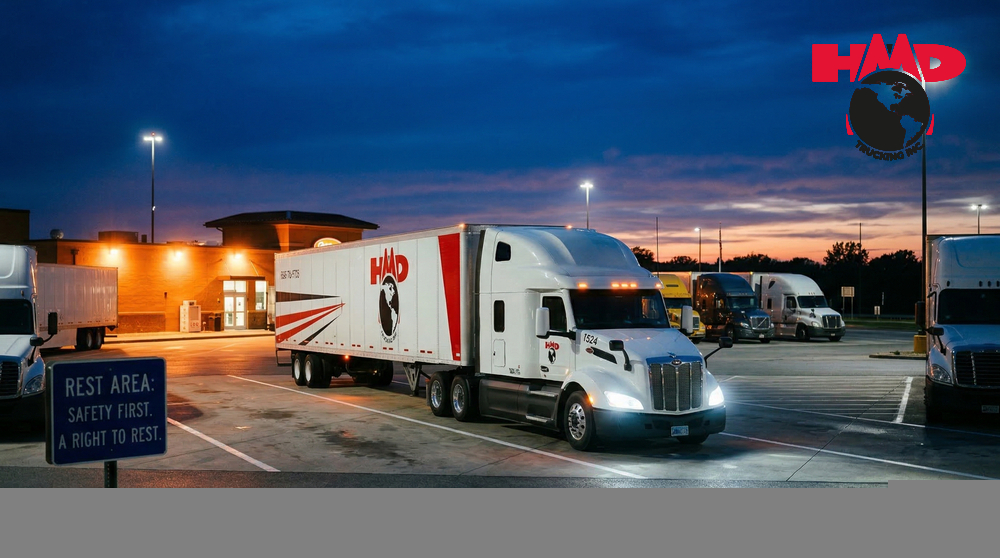
It is a nightly battle that puts immense stress on the job. As new reports about the Truck Parking Safety Improvement Act have it, there is a parking spot on the road for one of 11 trucks. A U.S. DOT report found that 98% of drivers report problems finding safe parking.
Drivers are forced to park on dangerous off-ramps or abandoned lots because a receiver held them up for hours and wouldn't let them park on the property. This is a basic safety issue. If you can’t guarantee a safe place to sleep, you can’t expect people to want the job.
2. Technology: Protection vs. Prying
With the arrival of new driver-facing cameras and the zealous monitoring of ELDs, there have been growing concerns regarding the invasion of privacy. In the past, drivers felt like "Captains of the Ship," but poorly managed technology can make them feel like monitored inmates.
Nowadays the realities of the world stress that the climate of the law has shifted. In contested concerns, whether the camera is facing inwards or outwards, the footage tends to vindicate the driver. Why? Because the overwhelming majority of drivers act in a professional and constructive manner. That footage is often the only evidence a driver has to protect themselves from a false accusation.
As much as we believe in the value of safety, we also believe in the value of choice and the value of transparency. We have a firm collection and deletion of biometrics to constitute the protection of your privacy. We recognize that the cabin is your home, and that is why we allow our drivers to sign a refusal regarding the deployment of inward-facing cameras. We provide the means to cover the lens and to control your privacy. We believe that cameras are beneficial, but that respect is of foremost importance.
3. Health and Demographics
The workforce is aging. The average age of a truck driver is now 47, a much older age than the average worker. When older drivers retire, it becomes difficult to replace them, not because young people “don’t want to work,” but because young people look at the lives – weeks away from home, unhealthy food choices, constant surveillance – and choose jobs that provide a better work-life balance.
Why the Narrative Persists?
If the data clearly shows we have plenty of CDL holders (states issue hundreds of thousands of new licenses every year), why do the big associations keep screaming about the 2026 truck driver shortage?
It comes down to political lobbying. By claiming there is a national crisis, large carriers can pressure Congress to pass laws that favor their business model.
We see this with the push for the Safe Driver Apprenticeship Pilot Program (SDAP). This program allows drivers under the age of 21 to haul interstate freight. The ATA lobbies hard for this, claiming it is necessary to fill the "shortage."
However, organizations like OOIDA and the Teamsters argue that the goal isn't necessarily to help young people start a career; it’s to flood the market with cheaper, younger labor. An influx of 18-year-olds keeps wages suppressed for experienced veterans. It is economically cheaper for a mega-carrier to burn through three new rookies in a year at a lower pay than to pay one veteran 20-year driver what they are actually worth.
Calling it a “truck driver shortage” shifts the blame. It suggests the problem is that Americans are lazy or unavailable. In reality, American workers are smart. Truck drivers look at the pay and the long hours away from home and decide that trucking just isn’t worth it. Many experienced truckers have had enough of the poor working conditions.
Is There a Truck Driver Shortage? What the 2026 Data Really Shows
Two months of 2026 have already passed, but the truck driver shortage is still scary. Both DAT and ACT Research forecast a contraction of the freight market for 2026. Volumes will likely increase, and capacity will look thinner. But do not let the headlines fool you. This tightness isn't because there are no drivers left in America. It is because the "freight recession" of 2023-2025 forced thousands of small carriers and owner-operators into bankruptcy.
We've cut capacity due to economic conditions. But now that the economy has turned around and the market has opened up, the shipper may find it difficult to find a truck. This is a “capacity correction,” not a labor issue. The truckers are still there; they've simply shifted over into construction, manufacturing, or local delivery gigs where they get paid for every hour they put in.
Conclusion
So, is there a truck driver shortage? No. There is a shortage of carriers willing to fix the bucket.
The solution involves expanding the pool of qualified talent – whether that means training locals or welcoming skilled drivers from overseas who are eager to work – and then treating them with the respect they deserve. It isn't lowering the driving age to put teenagers in 80,000-pound vehicles. The solution is treating the driver as the most valuable asset in the supply chain.
That means:
- Competitive Pay: Paying well above the mega-carrier rates to attract and retain the best professionals in the business.
- Respect: Ensure that drivers have a safe place to park their rigs and clean showers and that dispatchers are honest with them and treat them as partners rather than machines.
- Honesty: Acknowledge that the one and only metric that matters is retention.
At HMD Trucking, we aren't perfect. But we know the truth. We don't need more drivers in the industry. We need to take better care of the ones we have. We need to stop lying about a shortage and start telling the truth about the job. If we build the right jobs, the drivers will come – and more importantly, they will stay.