Imagine you are a fleet manager or a carrier owner. It is 3:00 AM, and your phone rings on the nightstand. It is one of your best drivers. He’s been stopped at a weigh station or roadside inspection point. He’s a hard worker. He’s never had an accident, and his logs are perfect. And then he says the words you dread: “They won't let me move the truck. I’m out of service.”
You ask why. Was it a brake issue? A tire? A lighting failure? No. The inspector decided the driver couldn't speak English well enough.
A couple of years ago, this would have been nearly impossible. While the rule requiring drivers to speak English has been in effect since 1937, it was seldom used as a primary reason to sideline a vehicle. It was more of a “paperwork” violation that could earn you a citation or a small fine, but rarely did it stop the wheels from turning. That all changed on June 25, 2025.
Now, a new landscape of enforcement is here. Thousands of drivers across the country have their jobs at stake due to the FMCSA English requirement. How did this come to be? What do inspectors expect from drivers? Why is this a huge impact on the entire American trucking industry? Let’s answer all these questions in detail.
Contents:
The Long Sleep of 49 CFR 391.11
To find out why this is such a sudden shock, we have to look at the history of the rule itself. The regulation is specified in 49 CFR 391.11(b)(2). It states that in order to be "qualified" to drive a commercial motor vehicle, one must be able to "read and speak the English language sufficiently to converse with the general public, to understand highway traffic signs and signals in the English language, to respond to official inquiries, and to make entries on reports and records."
For a long time, it stayed in the background of compliance. In 2016, the FMCSA sent out a memo, MC-ECE-2016-006, that essentially told inspectors, “Don’t place drivers out of service for language violations.” The memo would remain intact for almost a decade. During that period language violation statistics dropped from over 100,000 a year to less than 10,000. The industry adapted to a looser standard. Unable to find enough available driver workforce, some carriers began to expand by hiring more foreign-domiciled and immigrant drivers who had the skills to drive but might have had trouble with the language subtleties.
However, in April 2025 that ten-year sleep was shaken violently.
The 2025 Pivot: "Commonsense Rules of the Road"
On April 28, 2025, President Trump signed an executive order titled “Enforcing Commonsense Rules of the Road for America’s Truck Drivers.” The White House emphasized the importance of effective communication in ensuring safety on the highway. A big-rig driver who cannot read a “Hazmat Spill” sign or communicate with a police officer during an emergency situation poses a safety risk.
The Executive Order immediately did two things: it rescinded the 2016 memo that discouraged out-of-service orders, and it directed the Department of Transportation and the FMCSA to establish a new, stricter inspection procedure.
The Commercial Vehicle Safety Alliance (CVSA), which is the group of law enforcement officials that actually conducts the roadside inspections, didn't wait long to act. By June 25, 2025, they officially added “English Proficiency” to the North American Standard Out-of-Service Criteria. For the first time ever, the FMCSA language requirements actually meant something. And they looked threatening.
FMCSA English Language Proficiency: How the Test Works
A major concern among carriers and drivers is the “human element” of this enforcement. How does an inspector who isn’t a linguist decide whether a driver is “proficient”?
Currently, inspectors are trained to use a two-step assessment. It's not a written test; it's not a grammar assessment. It is meant to be a practical test of communication.
Step 1: The Driver Interview.
The inspection starts in English. The inspector asks standard questions about the trip: "Where are you coming from?” “What are you hauling?” “Can I see your logs and medical card?” If the driver does not respond appropriately to these basic "official inquiries," the inspector moves to the next step.
Step 2: Highway Traffic Sign Recognition.
If the conversation is a struggle, the inspector will show the driver some highway signs. The driver is to explain what the sign means – not just read the words but show that they understand the instructions. This includes temporary electronic message boards in construction zones or emergency situations.
What is frightening and unexpected to people is that if a driver fails that assessment, an out-of-service order is often automatic. Most states have “hardcoded” these violations into their inspection software –like SafeSpect – which means the inspector cannot even override the system to let the driver go with just a warning. Once the system flags the failure, the truck is grounded.
The 10,000-Driver Problem: Data and Reality
The effect of the change was swift and substantial. By the end of 2025, some 10,000 commercial drivers had been removed from the road for failing to meet the FMCSA English requirement. Secretary of Transportation Sean Duffy estimates the number could be as high as 20,000 in total since the crackdown began in June.
A three-day enforcement effort titled "Operation SafeDRIVE" placed nearly 500 drivers out of service for language violations. This operation took place in 26 states in early 2026.
This isn't a trivial compliance issue anymore. It's one of the most aggressively enforced driver qualification standards in the country. And the consequences are far more substantial than a service interruption. Once a driver is placed out of service, the carrier has to:
- Find another driver to handle the load.
- Pay for predatory towing or storage if the truck is not immediately moved.
- Communicate to the customer what went wrong with the service.
- Address the decline in their CSA safety scores.
The Labor Collision: Diversity vs. Compliance
This stricter enforcement of FMCSA language requirements is colliding head-on with the reality of the American workforce. According to industry reports, about 15.7% of truck drivers are immigrants, and roughly 3.8% are estimated to have limited English proficiency.
In particular, in a time when domestic recruitment has been hard, foreign-born drivers have provided a saving grace for many carriers. They are generally skilled workers who often take a lot of pride in what they do. But the new language “zero tolerance” policy is introducing a major labor barrier. It is making what was once considered a small “paperwork” gap an immediate operational halt.
It’s a difficult conversation. On one side, industry groups, such as the OOIDA, refer to it as a matter of “common sense” that an 80,000-lb vehicle must be driven by a person who can “read road signs and speak to the police.” On the other side, opponents are concerned it could also serve as an employment barrier or even a discrimination factor at a roadside checkpoint.
The 2026 Licensing Crackdown Connection
The use of English requirement should also be considered in the context of other recent developments. Initially, the FMCSA made a key ruling in March 2026 that significantly reduced the eligibility for “non-domiciled” CDLs.
Previously, drivers could use various work authorization documents to get a license. Now, eligibility is strictly limited to specific visa categories (H-2A, H-2B, and E-2): This licensing overhaul, coupled with the English crackdown, suggests a direct federal effort to limit the pool of who can legally operate a commercial vehicle in the United States.
The “safety first” approach was voiced by Secretary Duffy, who announced that in 2025 at least 17 fatal accidents were linked to non-domiciled drivers with unverified histories. Enforcing the English standard, the DOT is seeking to ensure that every driver who is on the road is fully “vetted” and can operate safely from the outset.
The Border Zone Exception: A Small Piece of Clarity
The rules are somewhat different for one area: the border commercial zones at the U.S.–Mexico border.
Following opposition and concerns about cross-border trade, the FMCSA amended this provision, calling strictly these narrow commercial areas (3 to 20 miles away from the border) exempt from the out-of-service portion of the rule. Drivers can still be cited for the violation, and it will be on their record, but the truck won't be grounded.
But once the driver exits the border zone and enters the “interstate” portion of the journey, the full enforcement policy applies. If they are caught on a highway in Texas or Arizona or anywhere beyond those specific zones, they immediately become subject to being put out of service.
How Carriers Can Adapt: A New Strategy for Success
So how do you handle this as a carrier? You can't just cross your fingers and hope your drivers don't get stopped. Hope is not a compliance strategy.
1. Screening During Onboarding.
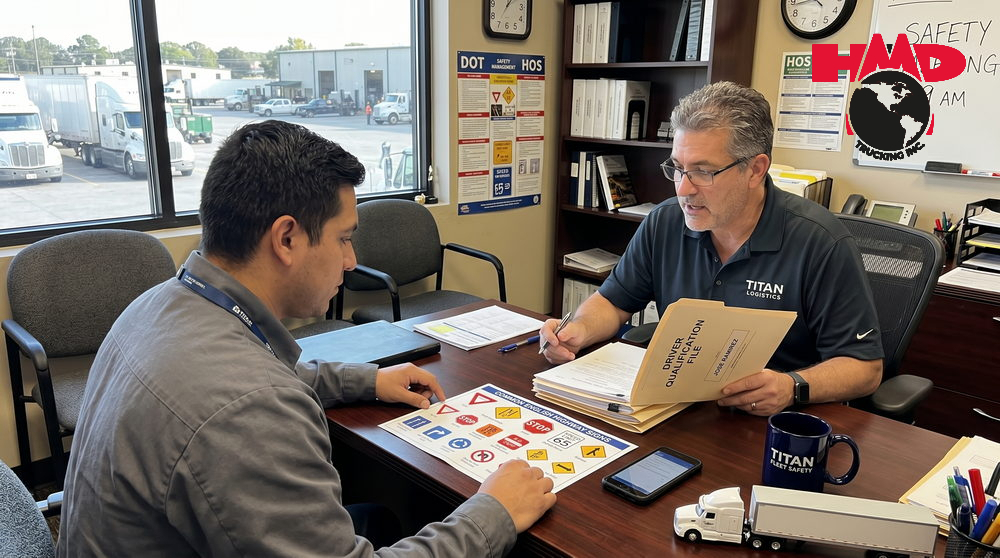
Do not assume that a driver with a valid CDL automatically meets the FMCSA English language proficiency standard. The CDL is a licensing credential, but the English requirement is a separate qualification standard. You should perform your own oral and reading assessment during the hiring procedure. Can they explain a traffic sign? Would they answer a hypothetical question about a roadside inspection?
2. Document everything.
Although there is no particular federal form for an English test, you should record in the Driver Qualification (DQ) file that you assessed their proficiency. This demonstrates “due diligence” if your files are audited by the DOT.
3. Language Training and Support.
Some carriers are now investing in language training for drivers. This is not just about passing an inspection; it’s about safety and efficiency. Making a driver more confident in their communication can prevent mistakes at the terminal, on the customer’s dock, and on the roadside.
4. Educate Your Dispatchers.
Instruct your dispatchers that this is an out-of-service violation. If they are sending a driver with limited English skills into an area known for high-visibility enforcement, they are taking a real financial risk with that load.
Contemplating the Road Ahead
Redefining English proficiency as an out-of-service violation is a classic example of how the trucking industry is evolving toward a "zero-defect" safety model. It is no longer enough to simply “get the job done.” You have to get the job done while meeting every single regulatory standard, no matter how minor you may have considered it in the past.
We are moving into a phase where the DOT is using every tool in the toolbox — licensing reforms, identity verification through systems like Motus, and more rigorous roadside standards — to clean up the industry. In the short run, this creates a major labor challenge, but, ultimately, it will result in a safer highway for everyone.
The ‘paperwork’ era is over. The "operational" era is here. For carriers that want to survive and thrive in 2026, the English requirement for FMCSA is to be considered with the same seriousness as hours-of-service compliance or vehicle maintenance. It’s not just about words; it’s about the safety of every driver on the road and the integrity of the freight they carry.