Tax Deductions for Truck Drivers: How to Lower Your Tax Bill?

by Michael Mahler — HMD Trucking
No matter how much experience you have in driving a truck, if you feel the call to explore the endless highways, you will enjoy every moment on the road. However this feeling typically disappears without a trace when the tax period approaches. Do you know how to avoid putting yourself under emotional strain and falling out of love with your life’s work? Take it easy and do not waste the opportunity to save your money with the help of tax deductions for truck drivers.
We have compiled some tips on how to manage various kinds of business expenses throughout the year to reduce annual state taxes and local taxes and reap eventual benefits.

Who Qualifies as a Truck Driver for Tax Purposes?
The most significant change in trucker taxes came with the Tax Cuts and Jobs Act of 2017. This law fundamentally changed who can deduct business expenses.
- Company Drivers (W-2 Employees): If you are a company driver and receive a W-2 form, you can no longer deduct unreimbursed work-related expenses. This includes things like tools, supplies, and other personal costs. The standard deduction was increased to compensate for the removal of these individual deductions.
- Owner-Operators & Independent Contractors (1099): If you are self-employed, you are still entitled to deduct all ordinary and necessary business expenses. You report your income and expenses on a Schedule C form, which allows you to lower your taxable income significantly. This article focuses on deductions for this group.

Requirements for Claiming Tax Deductions as a Truck Driver
The tax inspector determines whether you meet the requirements for claiming a tax deduction by checking tax documents you have.
A company driver now submits a W-2 and can no longer report separately such things as fuel expenses, maintenance or parking fees on truck driver tax credits.
Owner operators' tax write-offs are based on 1099-NECs, which they receive from their customers for each transaction exceeding $600 at the end of the year. They then fill in Schedule C for per diem expenses and Schedule SE for self-employment taxes. All these forms should be submitted along with Form 1040 to file an annual income tax return.

Common Tax Deductions for Truck Drivers
Deductible expenses for truck drivers include a long list of running costs, and to claim them you have to submit to the IRS a record of the expense, including receipts and other supporting documentation.
Truck Driving Education
It is very important for truck drivers to constantly improve their professional skills by adding endorsements. If you are going to attend a truck driving school to get a CDL, you can deduct the cost of tuition and manuals from your taxes. Note that if you are getting a degree in, say, medicine or law, you cannot count on tax deduction, because it is not related to truck driving.
Vehicle Expenses
As an independent owner-operator, your commercial tractor and trailer represent your largest operational investments. While standard mileage rates apply to passenger vehicles, IRS regulations require heavy commercial motor vehicles (Class 8 semi-trucks) to use the Actual Expense Method. You deduct the real dollar amounts spent operating your equipment throughout the tax year:
- Fuel & DEF: All diesel and diesel exhaust fluid purchases, including fuel card network transaction fees and state fuel taxes.
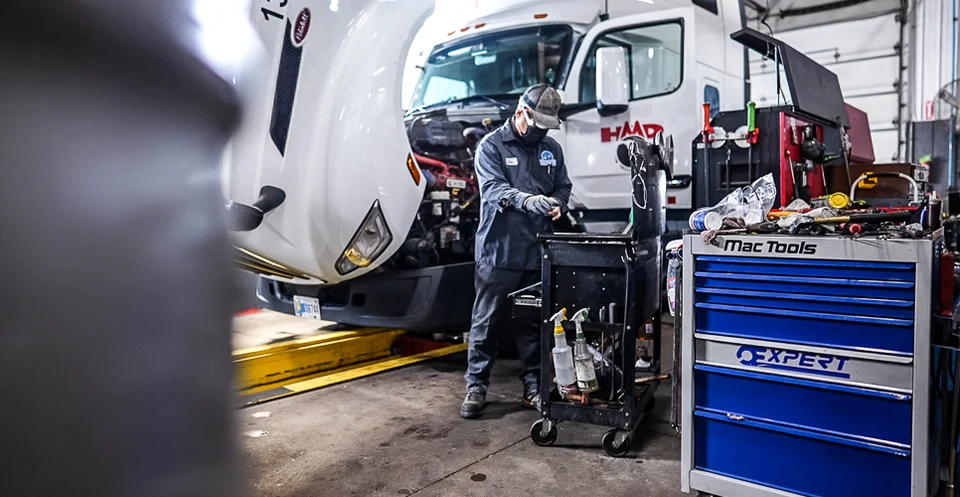
- Maintenance & Tires: Routine oil changes, annual DOT inspections, brake service, auxiliary power unit (APU) upkeep, and steer/drive tire replacements.
- Equipment Depreciation: Section 179 expensing and bonus depreciation allow you to write off substantial portions of your tractor purchase price in the first year.
- Lease Payments & Insurance: Monthly commercial tractor-trailer lease payments, loan interest, bobtail insurance, and primary physical damage coverage. Maintaining dedicated digital receipt archives and a separate business bank account ensures your deductions stand up to IRS audits.
Travel Expenses
Under IRS special transportation industry rules, the standard per diem rate for meals and incidental expenses (M&IE) is $80 per full day for travel within the continental United States (CONUS) and $60 per partial day (the day you depart and the day you return home). Under Department of Transportation (DOT) Hours of Service regulations, self-employed owner-operators claim an 80% deduction limit:
- Full-Day Tax Deduction: $64.00 per day ($80 x 80%).
- Partial-Day Tax Deduction: $48.00 per day ($60 x 80%). You do not need to save individual receipts for daily food, coffee, or showers. Your electronic logging device (ELD) records and carrier settlement sheets serve as primary substantiation, proving every overnight period spent working away from your permanent tax home.
Office Expenses
You are allowed to deduct certain office expenses, including software, photocopying, stationery (such as pens, staplers and paper clips), and postage. Be ready to show that these are requisite business expenses, not personal expenses.
Insurance Premiums
When determining the taxable amount, owner operators can cut off the value of insurance premiums associated with business, such as liability insurance, property damage insurance, and loss of income insurance that covers cargo damage or loss.
Self-employed drivers can also submit their personal health insurance receipts for tax deduction. As it is not a commercial expense, health insurance premiums are deductible as an “above the line” deduction on Form 1040.
Communication Expenses
All communication expenses, such as desktop or portable computers for work, or monthly ISP charges, are deductible. The costs of telephone service, communication equipment, mobile phones, and business calls while on a business trip, including sending faxes, are deductible as long as the taxpayer can justify them. Be ready to produce your contract with the mobile carrier or ISP if asked to.
Association Fees
Many self-employed truck drivers join trucker unions or other truck operator associations. This kind of membership provides a lot of benefits for small-business owners, such as access to exclusive products and valuable services that help their trucking business to grow. Association fees and dues are deductible.
Non-deductible Expenses for Truck Drivers
Self-employed drivers who receive 1099-NECs can claim most expenses related to their business for tax deduction. However, some expenses are not deductible. To avoid future penalties, be sure to submit the correct data for a tax deduction, done on a fair and reasonable basis that reflects the purpose of the expense.

Understanding what the IRS disallows protects your business from costly audit adjustments and penalty fees:
- Everyday Civilian Clothing: Standard jeans, casual shirts, and everyday winter jackets cannot be deducted—even if you wear them exclusively inside the truck. You may only deduct specialized personal protective equipment (PPE) like steel-toe safety boots, high-visibility vests, hard hats, load-securing gloves, and mandatory uniforms with permanent company logos.
- Personal Commuting Miles: Driving your personal vehicle from your residence to a terminal, drop yard, or maintenance shop is classified as personal commuting and cannot be written off on Schedule C.
- Reimbursed Expenses: Any operational cost directly reimbursed by a customer, freight broker, or carrier must be excluded from your itemized deductions.
- Local Driving Meals: Drivers who return to their permanent tax home daily without taking a mandatory overnight rest break cannot claim daily meal deductions or per diem rates.

Benefits of Claiming Tax Deductions as a Truck Driver
Claiming tax deductions that relate to your trucking business has many benefits, mainly because it allows you to save on taxes while getting things you need for doing business.
Reduce Your Taxable Income
By deducting the bulk of your expenses from your taxable income, you pay less in taxes. How does this work? You take your gross income and then calculate your adjusted gross income on your tax forms by reducing it by the amount of the deductible expenses. As a result, you only have the adjusted gross income amount taxed.
Get a Refund
Owner operators can claim a tax refund for the previous tax period. You are eligible for a refund when the taxes paid to the IRS are greater than the actual tax payable.
It actually means that you can get more tax refunds by expanding your list of owner operator tax deductions for the previous fiscal year.
Increased Cash Flow
You can cover the daily needs of your business without affecting your cash flow. You can even increase it by lowering your taxable income or getting tax refunds. Sounds great, doesn’t it?

List of Tax Deductions for Owner Operators
The list of standard tax deductions for owner operators typically includes the following:
- Fuel expenses;
- Repairs and maintenance, such as equipment expenses and depreciation;
- Office expenses;
- Insurance premiums;
- Licenses and permits;
- Depreciation;
- Rental and truck lease;
- Mileage deductions;
- Travel costs, such as meals, accommodation, parking and toll charges;
- Communication expenses;
- Association membership fees.

Conclusion
Managing your business deductions systematically throughout the year protects your revenue and minimizes tax liabilities. Keeping digital mileage records, fuel receipts, and maintenance logs ensures you claim every allowable dollar on Schedule C without stress at tax time. At HMD Trucking, we support professional drivers with transparent settlements, dependable freight volume, and modern equipment. Check out our open positions on our hazmat truck driver jobs page, or learn more about equipment choices in our guide on choosing between a flatbed or dry van trailer.