How Does Per Diem Work for Truck Drivers?
by Michael Mahler — HMD Trucking
The life of an over-the-road truck driver means you're constantly paying for meals and other small expenses. To help with these costs, the IRS allows for a special daily allowance, known as "per diem."
However, how per diem affects your wallet is completely different depending on whether you're a company driver (W-2 employee) or a self-employed owner-operator. Understanding this difference is the most important part of understanding per diem.
This guide will break down exactly what you need to know for your situation.
What Is Per Diem Pay for Truck Drivers?

Under official IRS guidelines (Notice 2024-68 and Notice 2025-54), the special transportation industry Meals and Incidental Expenses (M&IE) per diem rate is $80 per full day for travel within the continental United States (CONUS) and $86 per full day for travel outside the continental United States (OCONUS, including Canada). For partial travel days (the day you depart and the day you return home), the allowable rate is calculated at 75%, providing $60 per partial day for CONUS routes. This non-taxable allowance covers daily food, beverages, and minor incidental expenses while you operate away from your permanent tax home.
- You must have a purpose for travel, which in this case is to deliver goods and services.
- You must keep a detailed log showing descriptions of reasonable travel-related expenses.
- You have living expenses at your main home that you duplicate because your business requires you to be away from that home.
- You have not abandoned the area in which both your historical place of residence and your claimed main home are located; you have a member or members of your family living at your main home, or you often use that home for residing.
- You perform part of your business in the area of your main home and use that home for residing while doing business in the area.
- If the company offers you an allowance beyond what you are entitled to, you’ll have to return the remainder.
- Only OTR drivers are entitled to the per diem payment plan because they have to spend long hours away from home.
Caveat: Points 3 through 5 are essential for the IRS to establish your tax home.
How to Calculate Per Diem Rates?
According to IRS Publication 463, drivers don’t need to itemize their purchases when filing their taxes. But you still need to save your receipts just in case the tax collector asks for them.
Also, the driver’s salary is divided into two categories: the regular cents-per-mile earnings (taxed) and a separate per diem reimbursement (untaxed).
Starting in 2024, the IRS has increased the per diem rate for truckers to $80 per full day of travel within the Continental U.S. While truckers can still only claim 80% of this amount as a tax deduction, that means you can now deduct $64 per full day. For partial days, 75% of the full rate applies, so the deduction for a partial day would be $60.
While this is the average rate nationwide, the cost of living arrangements can vary by state. For example, housing is more expensive in New York and California than in other parts of the country. You should use the per diem calculator to estimate your daily entitlement for meals, lodging, and clothing.
To find out more about the per diem rates for truck drivers, reach out to a local tax expert and/or financial professional to give you the latest info.
Who is Eligible for Per Diem?
The main rule is that you must be traveling away from your "tax home" – the city or general area where your main place of business is located – for a period that is substantially longer than a normal workday and requires you to get sleep or rest. For an OTR trucker, this is almost every day on the road.
How Does Per Diem Work for Truck Drivers?
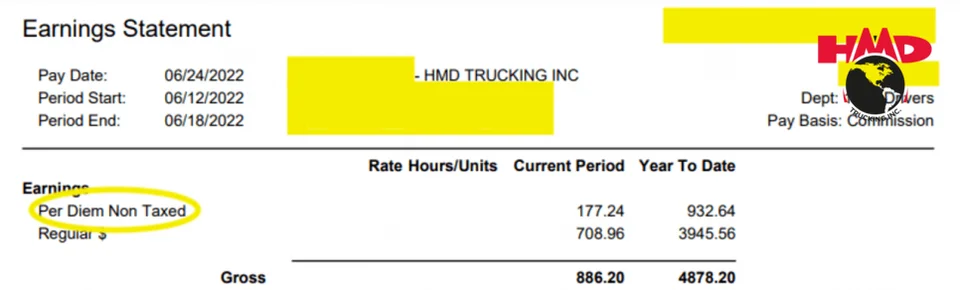
If you're a W-2 company driver, you do not take a tax deduction for per diem. Instead, a company might offer you a "per diem pay plan."
How it Works: The company splits your paycheck into two parts:
- Taxable Wages: Your regular cents-per-mile (CPM) earnings. This is taxed as normal.
- Non-Taxable Per Diem: A portion of your earnings is paid to you as a non-taxable reimbursement, up to the IRS limit of $69/day.
Example:
Let's say your gross pay for a week is $1,500, and you were on the road for 5 full days.
- Without Per Diem: Your entire $1,500 is taxed.
- With a Per Diem Plan: The company could classify 5 days x $69 = $345 as non-taxable per diem. Your paycheck would look like this:
- Taxable Income: $1,155 ($1,500 - $345)
- Non-Taxable Per Diem: $345
- Result: You only pay income tax, Social Security, and Medicare on $1,155. This means your weekly take-home pay is higher.
The Pros and Cons of a Per Diem Pay Plan
A per diem plan isn't just "free money." It's a trade-off you need to understand.
Recent Tax Changes to Monitor

Tax laws governing commercial drivers draw a strict distinction between W-2 company drivers and independent 1099 owner-operators. Under Tax Cuts and Jobs Act provisions, W-2 company drivers cannot deduct unreimbursed travel expenses or per diem on Schedule A; they can only receive tax-free per diem through an employer's IRS-compliant accountable plan. For self-employed 1099 owner-operators filing Schedule C, the temporary pandemic-era 100% restaurant deduction has expired. Under Internal Revenue Code § 274(n)(3), drivers subject to Department of Transportation (DOT) Hours of Service limits can deduct 80% of the $80 daily rate, yielding an allowable tax deduction of $64 per full travel day.
Advantages of Per Diem

Per diem pay for truckers comes with many benefits that every truck driver should consider before signing a contract. Let’s check them out.
You’ll Manage Your Spending Better
Under the per diem payment model, the company gives you the meal allowance beforehand. This means you will get a better picture of how much spending power you have before buying anything. If you are a driver eager to maintain a sustainable spending habit, the per diem model will fit you like a glove.
You Will Pay Less in Taxes
As mentioned earlier, you don’t need to pay taxes on your per diem allowance. Since companies that offer per diem payments also offer lower salaries, this means that you have a lower adjusted gross income. This, in turn, likely entitles you to a bigger tax refund as well as a lower tax indebtedness.
What’s more, companies that offer pay per diem often help their drivers manage their tax payments. This will come in handy should you find yourself struggling to file your taxes.
Lower Income Gives You Access to Social Programs
Even though with per diem you will earn a smaller gross income than the average trucker pay (truckers who work without the per diem allowance), you might still be entitled to social programs like Welfare or Temporary Assistance for Needy Families (TANF).
Disadvantages of Per Diem Pay

Despite the tax deductible advantages and reimbursements from per diem pay, this program still has several aspects that could be drawbacks for drivers. Let’s check out the disadvantages of per diem for truckers.
It Affects Your Annual Income
Companies that offer per diem pay usually offer wages lower than the market average, because they are giving you an additional allowance for food, lodging, and other expenses. In effect, you will end up earning less than your counterparts for the same workload and at the same experience level.
It Limits Your Chances of Getting a Loan
While participating in an employer per diem plan increases weekly take-home pay, reducing reported taxable wages involves specific financial trade-offs:
- Mortgage and Loan Approvals: Mortgage underwriters calculate debt-to-income (DTI) ratios using taxable W-2 Box 1 wages. If non-taxable per diem is not broken out separately on your paystubs, qualifying for large home loans or vehicle financing can be more difficult.
- 401(k) Employer Matches: When carrier 401(k) match formulas calculate contributions strictly from taxable earnings rather than total gross revenue, your employer match dollar amount will be slightly lower.
- Social Security & Disability Accruals: Paying less FICA tax means lower lifetime reported earnings, which can slightly reduce future Social Security retirement benefits and state unemployment payout caps.
You Might Still Need to Pay
Even though you are allowed to take the tax reimbursements for your per diem wages, you are not eligible for the standard deduction. So if your current salary exceeds the limit specified by the IRS, you’ll still need to pay for the coverage.
Meaning of Per Diem for the Company

Companies are adopting the per diem program for their employees for many reasons, chief of which is that, by doing so, they’ll then pay lower wages. But beyond these obvious financial benefits for the company, the idea of lower payroll taxes makes the per diem program attractive for employers.
In the current market, some companies offer per diem as an option, while others use this model exclusively across the board. Offering per diem pay as an option will help your company attract more qualified and experienced drivers.
Also, some companies want to help their employees stay on the right side of the law by covering their taxes for them. This is a win-win for all parties involved.
Either way, the choice remains with the driver to work with a trucking company that offers per diem compensation or to find an alternative if that’s considered more favorable.
Conclusion
Choosing whether to enroll in a per diem plan comes down to balancing higher weekly net cash flow against your long-term borrowing goals. At HMD Trucking, we offer an IRS-compliant accountable per diem plan providing a $0.12 CPM non-taxable reimbursement, giving company drivers maximum take-home pay on every settlement. We pair tax efficiency with market-leading compensation and late-model equipment:
- OTR Dry Van Solo: Earn 65 to 75 CPM ($1,350–$2,250 weekly gross) backed by a $2,500 sign-on bonus.
- OTR Flatbed Solo: Command 70 to 80 CPM ($1,505–$2,175 weekly gross) plus a $5,000 sign-on bonus.
- OTR Dry Van Team: 82*–87 CPM (split, includes base pay and bonuses). Weekly pay range: $3,550-$4,750 (split).
- OTR Hazmat/Doubles Team: 82*–89 CPM (split, includes base pay, hazmat/doubles pay, and bonuses). Weekly pay range: $3,650-$4,950 (split). (* When 95% service is achieved)
- Fleet Equipment: Run modern 2023–2027 Peterbilt 579 tractors featuring spacious sleeper cabs, refrigerators, and 2,000W inverters, backed by $175 layover pay per 24 hours. Apply today to join a Chicago-based carrier that respects your earnings and supports your financial success.