USMCA Rules of Origin: Surviving Digital Customs Audits
by Michael Mahler — HMD Trucking
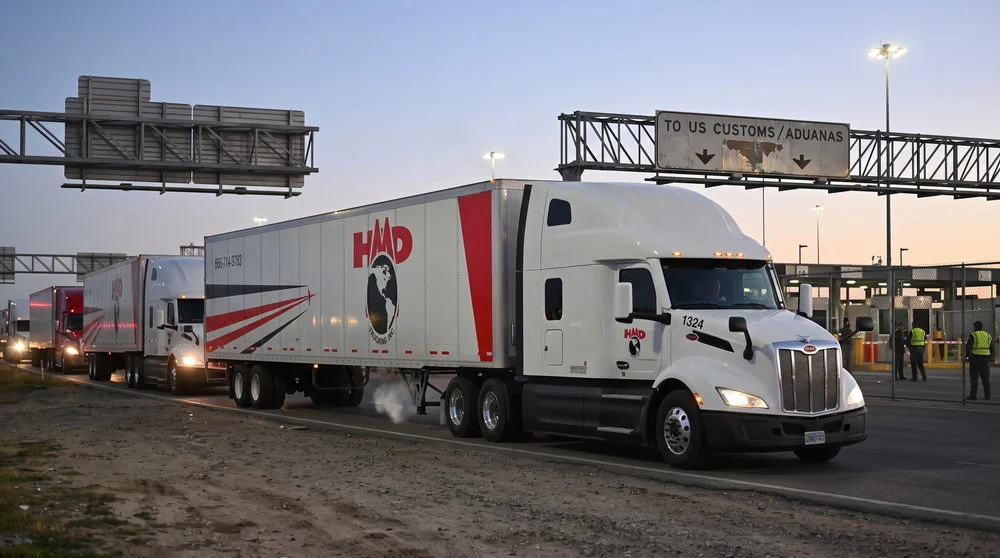
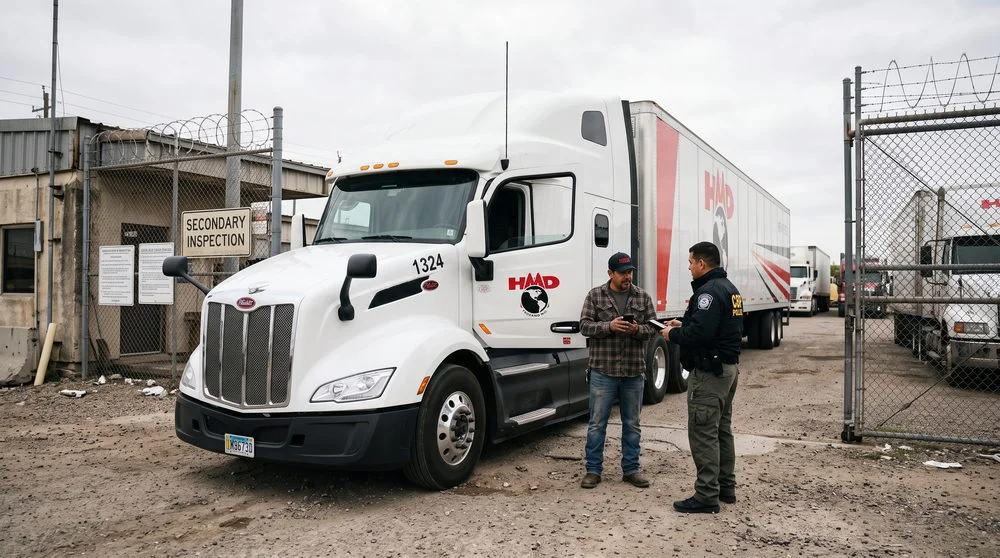
For carriers and commercial shippers bringing their freight through the World Trade Bridge in Laredo, there is nothing that will eat up the bottom line faster than a referral to secondary inspection. Once a discrepancy is flagged by the automated customs system, all of the drive time goes away, scheduling is out of the question, and valuable cargo is held until documentation is sorted out. In today's cross-border logistics environment, administrative friction is the ultimate bottleneck.
At the moment, American freight is experiencing one of the largest geographic shakeups since the construction of the Interstate Highway System. Nearshoring has resulted in a tremendous influx of manufacturing capacity back into our hemisphere. Factories in northern and central Mexico are manufacturing automotive parts, electronics, steel fabrications, and heavy machinery in large quantities. That freight comes north and into our heartland. At HMD Trucking, with our fleet based in Chicago, we see that freight surge daily on the I-35 and I-55 corridors.
Crossing the international border in modern trucking is not defined by horsepower, trailers, and dispatching skills. Digital compliance is key. The seamless movement of cargo requires adherence to the rules of origin under USMCA and quick digital customs inspection. Should the digital documentation not match the physical cargo in your trailer down to the last screw, the cargo stops. When the cargo stops, we all lose.
The Backbone of Cross-Border Trade: Understanding USMCA Chapter 4
When the United States-Mexico-Canada Agreement was enacted, it took the place of the old NAFTA agreement with more stringent requirements. At the center of this framework is USMCA chapter 4. This chapter lays out legal requirements to determine whether a product qualifies for North American status and can enter duty-free.
Many freighters and new freight brokers wrongly assume that manufacturing or assembling a product in Mexico automatically makes it duty-free. The customs authorities disagree. Labeling an electrical junction box with “Hecho en México” or performing simple assembly using foreign materials in a border plant does not satisfy the requirement. Chapter 4 was crafted to prevent foreign producers, particularly those from non-market economies, from exporting their low-cost components to Mexico, performing simple cosmetic work, and exporting the finished goods to the U.S. duty-free.
USMCA chapter 4 requires every product entering the United States under a tariff preference to fulfill certain origin requirements.
The Four Core Origin Criteria
There are four modes by which goods may be deemed originating under the agreement:
Criterion A (Wholly Obtained or Produced): This criterion applies to raw materials that have been wholly grown, harvested, or produced in the US, Mexico, or Canada. For example, timber from the Pacific Northwest, crude oil from West Texas, or grain from the Midwest. Foreign content is not present.
Criterion B (Produced Exclusively from Originating Materials): This is for manufactured goods where all of the raw parts and intermediate inputs are themselves originating. All components, wires, bolts, coatings, etc., must be made in North America.
Criterion C (Tariff Classification Change): This is the predominant principle in industrial manufacturing and nearshoring. Non-originating foreign inputs are allowed, but they must be transformed in North America in such a way as to physically transform the item and move its six-digit Harmonized System tariff code to a new classification. The degree of change – Chapter, Heading, or Subheading – is dependent upon the product rule contained in Annex 4-B to the treaty.
Criterion D (Regional Value Content): If a tariff change alone is not sufficient, then the goods must fulfill a Regional Value Content requirement. A certain percentage of the economic value of the product must be created in the USMCA trade area.
Calculating Regional Value Content: The Formulas
When product-specific rules require Regional Value Content calculations, USMCA chapter 4 gives shippers and manufacturers two primary calculation formulas: the Transaction Value Method and the Net Cost Method.
The Transaction Value Method calculates the North American proportion based on the final sales price of the product:
| TV – VNM | ×100 |
TV |
In this formula, RVC represents the Regional Value Content percentage, TV is the transaction value or purchase price of the finished item, and VNM is the value of non-originating foreign materials used during manufacturing. Under USMCA chapter 4, standard manufactured items generally require a minimum RVC of 60 percent under this transaction method.
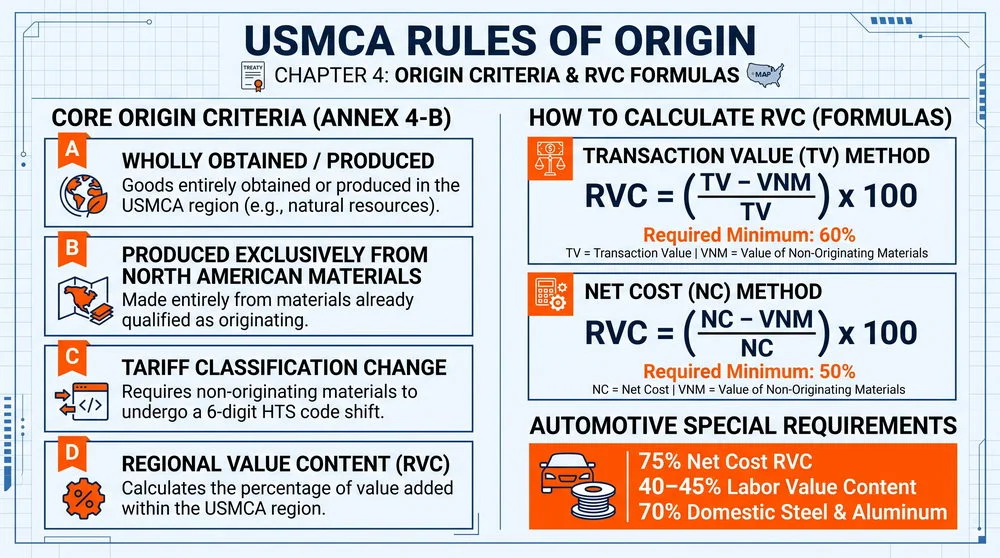
The Net Cost Method calculates the ratio by stripping away overhead, marketing, royalties, and transportation expenses, focusing purely on direct manufacturing costs:
| NC – VNM | ×100 |
NC |
Here, NC represents the net cost of production, and VNM represents the value of foreign non-originating inputs. For most standard products, the baseline threshold under the Net Cost Method is 50 percent.

The Heavy Stakes in Automotive Freight
The rules become significantly tougher when hauling automotive cargo. Under the Chapter 4 Appendix, passenger cars, light pickup trucks, and heavy commercial tractors face a 75 percent Regional Value Content requirement calculated strictly under the Net Cost Method, up from the historical 62.5 percent required by NAFTA.
Automotive freight must also meet the Labor Value Content rule, which mandates that 40 to 45 percent of vehicle value comes from manufacturing facilities paying production workers at least 16 dollars per hour. On top of that, vehicle manufacturers must prove that at least 70 percent of their annual steel and aluminum purchases originate from North American mills.
The De Minimis Lifesaver
One key safety measure in USMCA Chapter 4, saving freight from falling out of compliance, is the de minimis provision. According to Article 4.12 of the chapter, if the final product has some parts that do not fulfill the required tariff shift, but their value does not exceed 10 percent of the value or net cost of the good, then the product will be considered as originating in the country. The purpose of the 10 percent limitation is to prevent expensive machinery from losing its eligibility for zero duties because of minor details like washers, O-rings, or other small foreign-made components.
Product Category | Qualifying Origin Criterion | Required Value Content Threshold | Sourcing and Compliance Focus | Legal Governing Reference |
|---|---|---|---|---|
Industrial Machinery & Tools | Tariff Shift (Annex 4-B) or RVC | 60% Transaction Value / 50% Net Cost | Substantial mechanical processing within North America | USMCA Ch. 4, Art. 4.5 |
Passenger Cars & Light Trucks | Net Cost RVC + Labor Content + Metals | 75% Net Cost | 40%–45% labor value at ≥$16/hour; 70% domestic steel and aluminum | USMCA Ch. 4 Appendix |
Core Automotive Components | Direct Tariff Shift & High Net Cost | 75% Net Cost | Origin tracking for drivetrains, engines, and structural stampings | USMCA Annex 4-B |
Heavy Commercial Tractors | Net Cost RVC + Structural Sourcing | 70% Net Cost | Traceable chassis manufacturing and domestic powertrain sourcing | USMCA Ch. 4 Appendix |
Apparel & Industrial Textiles | Yarn-Forward Transformation (Chapter 6) | Not Applicable (Process-specific shift) | Raw fiber spinning and weaving within treaty borders; 10% weight de minimis | USMCA Ch. 6, Art. 6.1 |
The Digital Customs Audit
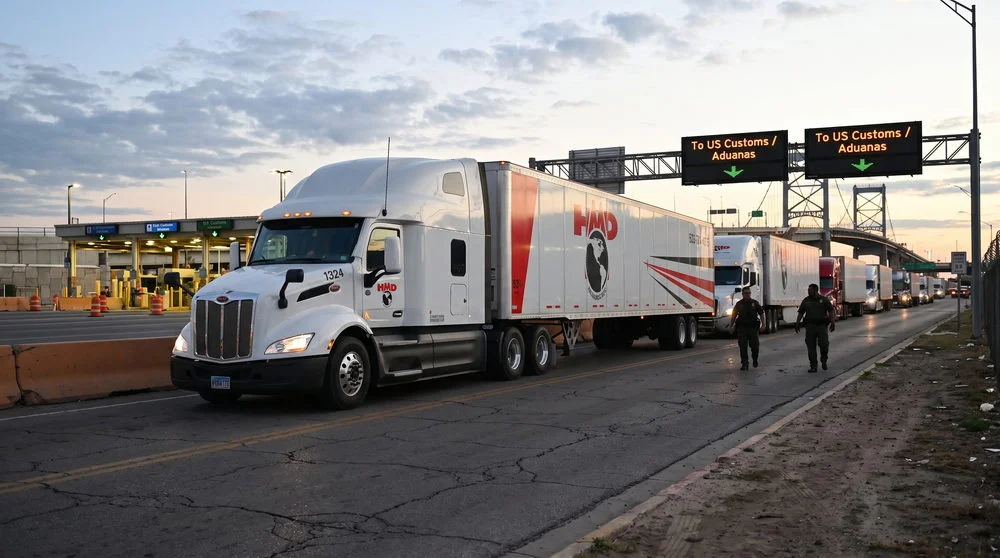
Goodbye to handing over mountains of paper documents in a glass booth – cross-border freight now relies on automated, interconnected digital customs solutions. The United States' Customs and Border Protection (CBP) and Mexico's Servicio de Administración Tributaria (SAT) use sophisticated digital screening platforms, which evaluate the trade documentation prior to the arrival of the truck at the international bridge.
Customs and Border Protection (CBP) and the Automated Commercial Environment
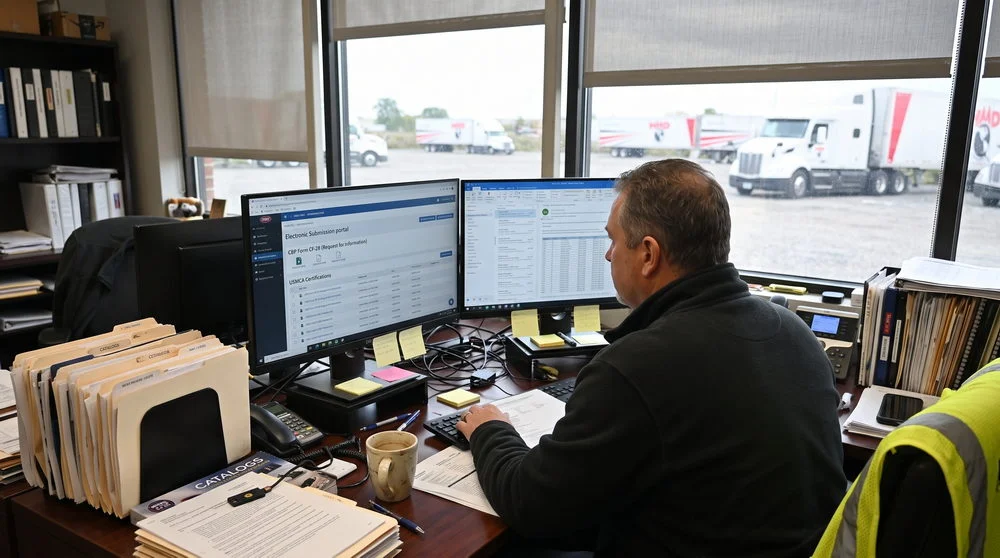
In the U.S., CBP makes use of the Automated Commercial Environment (ACE). ACE is a centralized digital ledger connecting customs brokers, carrier electronic manifests, and automated screening systems. Upon submission of the electronic manifest by a carrier, the system compares the cargo against the import filings, historical price information, and manufacturer declarations.
If the system discovers classification issues, unrealistic value calculations, or missing certifications, CBP sends out a digital audit notice. The most common type of the notice is CBP Form CF-28 (Request for Information). Using that form, federal auditors require the importers to provide the complete and auditable evidence that their cargo meets all the requirements set forth in USMCA rules of origin. The request includes detailed supplier bills of materials, raw material invoices, and origin declarations.
Failure to provide such records during the thirty-day period, or any inconsistencies with the calculation, will lead to CBP requesting Form CF-29 (Notice of Action). That form cancels any duty-free status, puts into place retroactive tariffs, collects penalties, and places future shipments originating from the same shipper or carrier under physical inspection. According to USMCA Chapter 5, customs authorities can perform on-site audits at Mexican facilities and request five-year production and financial records.
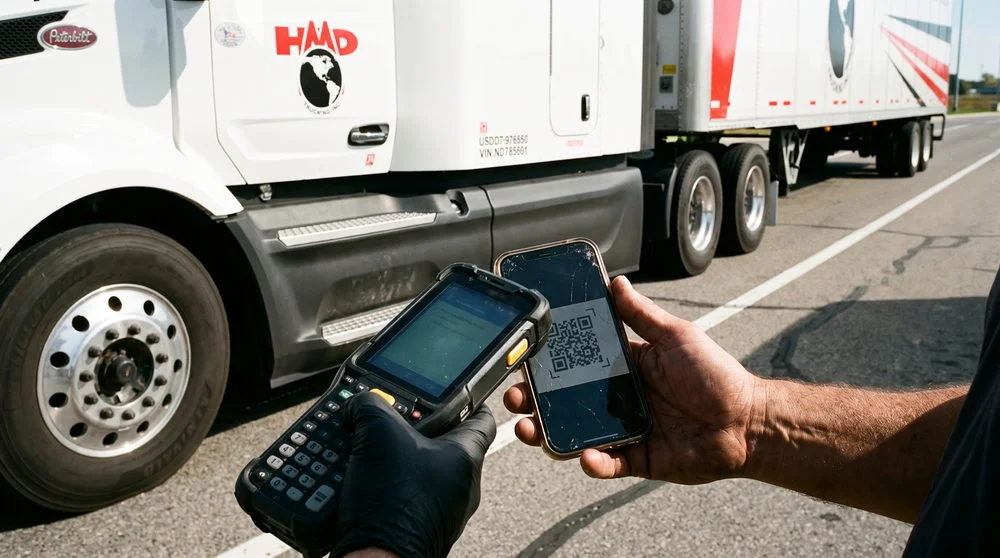
Mexico's Complemento Carta Porte 3.0 Mandate
South of the border, the regulatory environment is equally rigorous. Since 2022, SAT has mandated the Complemento Carta Porte, an electronic transport document attached to Mexico's digital tax invoice (CFDI) system. Now running on version 3.0, this digital manifest serves as an electronic bill of lading that validates the legal transport of freight throughout Mexican territory.
Complemento Carta Porte 3.0 requires an immense amount of operational data. Every digital document must include over 140 specific data points before the truck departs:
Exact satellite coordinates for origin pickup, planned route stops, and final border transfer gates.
Complete driver identity credentials, Mexican RFC tax identifiers, and official transport operating licenses.
Specific tractor registrations, trailer license plates, SCT environmental permits, and commercial insurance coverage data.
Granular commodity descriptions mapped directly to SAT product keys, piece counts, net weights, and declared monetary values.
The Mexican border control utilizes automated optical scanners and transponder readers at the border. approaches. The scanners check for a match between the plate number of the tractor and trailer with the SAT tax system database in real time. In case there is any typo on the driver’s license number, weight mismatch, or wrong product key, then the truck is immediately stopped. Even if the trucker has a flawless safety record, the truck will be stopped unless there is an authorized digital Carta Porte chain, and the carrier will face vehicle impoundment and severe tax fines.
Regulatory Body | Electronic Platform | Primary Enforcement Directive | Recordkeeping Mandate | Core Audit Verification Objective |
|---|---|---|---|---|
U.S. Customs and Border Protection (CBP) | Automated Commercial Environment (ACE) | 19 CFR Part 182; Form CF-28 and Form CF-29 | 5-Year Mandatory Window | Verifying USMCA rules of origin, regional value content math, and tier-two supplier affidavits |
Servicio de Administración Tributaria (SAT) | Portal Fiscal CFDI (Versión 3.0) | Complemento Carta Porte; Código Fiscal de la Federación | 5-Year Mandatory Window | Real-time shipment tracking, verifying legal cargo possession, and matching RFC tax IDs |
Agencia Nacional de Aduanas de México (ANAM) | Sistema Automatizado Aduanero Integral | Pedimento de Importación y Exportación | 5-Year Mandatory Window | Classifying Harmonized System tariffs, verifying importer registers, and catching cargo discrepancies |
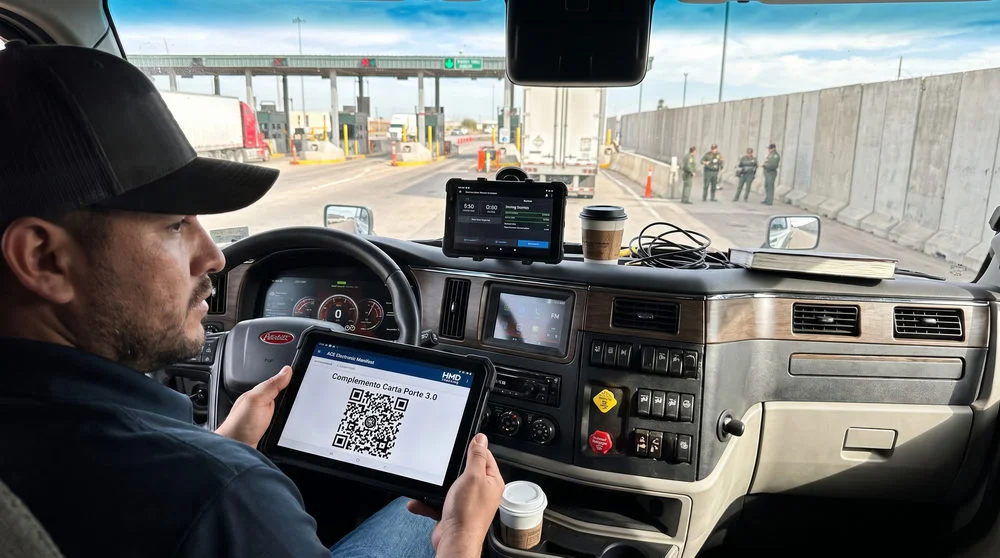
The True Cost of Border Delays
Idle trucks do not earn money, whereas fixed costs continue to grow in commercial trucking. An idle tractor transporting time-critical automotive parts or machinery is losing money while waiting for paperwork. A usual transit time can be 24 hours in border cities like Laredo, but sometimes the delay is 4-5 days due to paperwork issues.
Industry statistics show that over 80 percent of cross-border shipment holds are caused by paperwork and data errors, not by mechanical safety issues. Small mistakes made during the exchange of paperwork between countries can cause significant problems in operations.
Typically, the following scenario takes place:
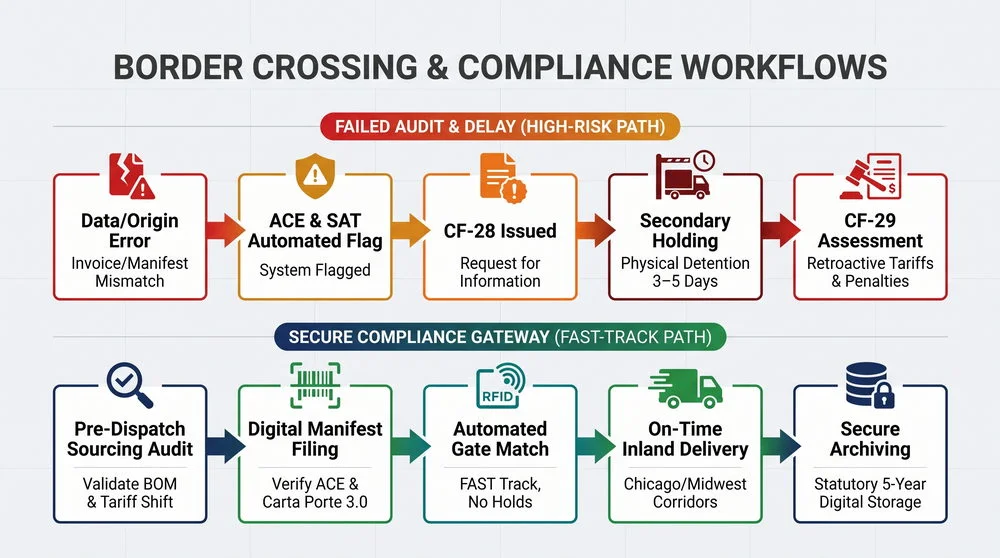
Initial Data Error: A clerical mistake occurs in the shipper's warehouse invoice or inventory data.
Incomplete Certification: An incomplete USMCA origin certification is created based on this erroneous invoice data.
Automated Alert: The customs computer in ACE or SAT identifies this shipment for further scrutiny.
Physical Detention: The tractor-trailer is moved to a bonded holding yard, causing 3-5 days of delay for brokers to sort out the issue.
Cascading Losses: Detention charges for the driver, yard demurrage, and plant shutdown penalties accumulate rapidly.
The Nine Mandatory Elements of USMCA Certification
Under NAFTA, the government had an official form: Form 434. Under USMCA, the form is not required anymore. Today, the origin certification can be included in the commercial invoice, packing list, or any other electronic document.
Flexibility in origin certification paperwork makes some people think that customs paperwork became easier. This is not the case. Annex 5-A of the agreement states that each valid origin certification must contain nine required data elements:
Certifier Status: Identifying if the certifier is the importer, exporter, or producer.
Certifier Contact Information: Complete the legal name of the business, title, address, phone number, and official email.
Exporter Contact Information: Complete business name, street address, and contact information (if different from the certifier).
Producer Contact Information: Name, plant address, and contact information.
Importer Contact Information: Complete legal name, registered corporate address, and contact information in the destination country.
Merchandise Description & HS Tariff Code: Clear trade description and the universal six-digit Harmonized System classification code.
Origin Criterion: The exact qualifying basis of origin under USMCA chapter 4 (Criterion A, B, C, or D).
Blanket Period: The time span, up to 12 months, when shipments remain the same and continuous.
Authorized Signature & Legal Attestation: The certifier signs and dates the statement declaring legal origin and the supporting documentation.
In case the shipping document lacks an email address, contains an expired blanket period, or quotes an old six-digit tariff code, the digital clearinghouse rejects the origin certification. As a result, the cargo is not eligible for duty-free treatment, standard import duties are applied, and the trailer moves to the red inspection lane for manual processing.
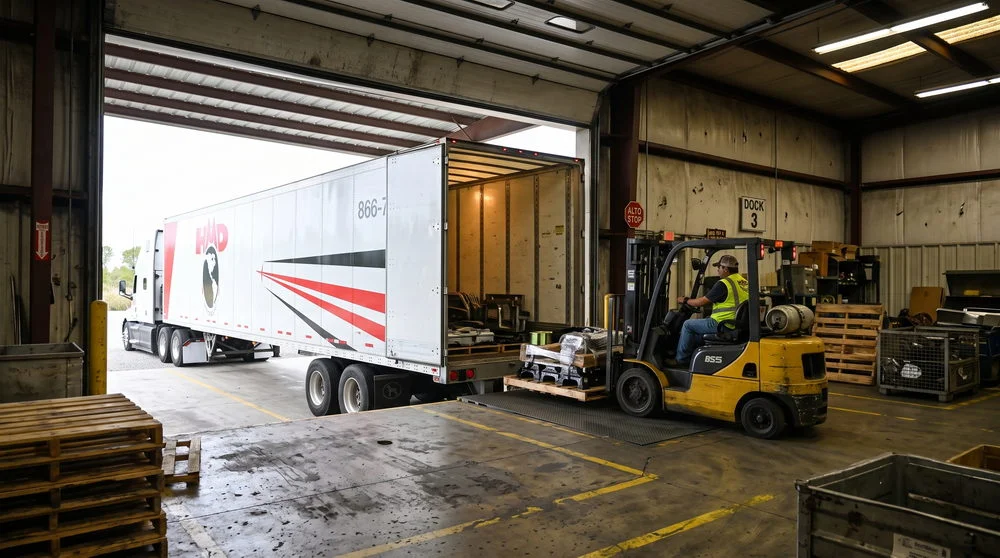
The Ripple Effect on Fleets and Drivers
If a shipment is held up in customs red tape, the repercussions ripple through the supply chain:
Driver Detention and Loss of Earnings: Drivers lose time while sitting in customs areas, reducing their earnings and disrupting their work week schedule.
Demurrage at Bonded Yard: Higher demurrage charges for storage of detained trucks until paperwork errors are corrected.
Assembly Line Disruptions: Just-in-time assembly lines require delivery on time; a late truckload of parts may cause an assembly line to stop working, triggering heavy contractual delays.
Retroactive Tariff Reassessment: In case of an audit that does not find any preferential treatment under USMCA chapter 4, the shipper will have to pay additional retroactive duties and penalties.
Border Checkpoint | Common Administrative Failure Point | Financial and Operational Consequences | Typical Resolution Time | Primary Reference |
|---|---|---|---|---|
Shipper Dispatch Gate | Mismatched piece counts between Commercial Invoice and Carta Porte | Rejection at Mexican customs approach; vehicle grounded inland | 12 to 24 Hours | SAT Regulatory Norms |
Primary Inspection Booth | Discrepancy in declared six-digit HTS tariff classification | Revocation of duty-free status; trailer rerouted to secondary inspection | 24 to 72 Hours | CBP Directive 19 CFR 182 |
Secondary Holding Facility | Missing mandatory Annex 5-A data points on origin certification | Physical trailer impoundment, bonded demurrage fees, broker escalation | 2 to 5 Business Days | USMCA Origin Procedures |
Post-Clearance Customs Audit | Inability to produce verified supplier bills of materials under CF-28 | Retroactive duty charges, cancellation of import bond, carrier audit | 30 to 60 Days | CBP Trade Enforcement |
Audit Readiness and Risk Mitigation
Preventing border delays requires just as much consideration as vehicle maintenance and driver safety. A good logistics chain cannot depend on luck at the border. Rather, it needs to have a process that ensures all details are reviewed prior to the dispatch of the truck.
A dependable compliance workflow covers four primary phases:
Pre-Dispatch Verification: Sourcing engineers verify bills of materials, confirm tariff shifts under Annex 4-B, and draft nine-point origin certifications under Annex 5-A.
Digital Coordination: Shippers and transport partners validate the electronic CFDI-Carta Porte 3.0 chain and pre-file carrier electronic manifests into ACE.
Cross Border Monitoring: Fleets use FAST lane clearance, verified border crossings, and automated transponder gates to avoid standard inspection delays.
Post-Clearance Archiving: Compliance teams maintain a secure digital repository of all manifests, certifications, and supplier affidavits for the statutory five-year window.
The Role of Reliable Carriers: The Chicago Connection
The above workflow explains the need for a corporate shipper to engage a professional and experienced motor carrier. Being located in Chicago – a historical intersection of all North American transportation services – we at HMD Trucking understand the reality of cross-border freight.
Operating a state-of-the-art late model fleet of over 650 tractors and 1,200 trailers, we connect the Midwest manufacturing and distribution corridors directly to the Mexican border. We know that administrative compliance is as important for our customers as the tractor's horsepower and reliable on-time delivery.
A corporate shipper cannot afford cross-border moves to rely on luck. When a cargo passes through our network, our safety and administrative systems coordinate with the shippers, customs brokers, and interchange partners. We will verify that bills of lading match commercial invoices, that the electronic manifests match customs declarations, and that the transit is monitored by satellite telematics. Our administrative diligence provides our corporate clients with assurance that their freight is secure, compliant, and protected from any delay in border crossing.
Building a Bulletproof Audit Defense
Preparation for the customs audit is an operational process, not an emergency one triggered by a notice from the government. To survive the customs audit in its digital form or a formal review in accordance with USMCA Chapter 5, a company should develop and adhere to the following operating discipline:
Maintain a Centralized Five-Year Archive: store every digital document, including commercial invoice, bill of lading, USMCA certification of origin, entry pedimento, and delivery receipt, in a secure digital repository for at least five years.
Conduct sourcing audits every six months: If your tier-two supplier changes the sources of components from North America to abroad, you shift your Regional Value Content percentage, possibly losing your duty-free qualification under USMCA Chapter 4.
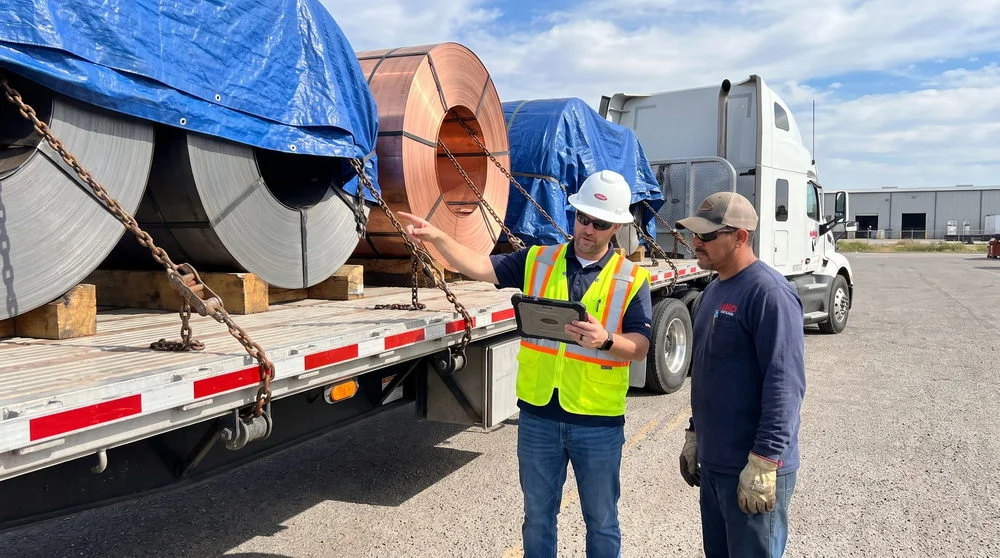
Have a Protocol for Ingesting of CF-28s: establish a formal procedure in your organization to react to customs inquiries and make sure that your customs broker, corporate accounting, and freight carrier team will work together in providing the supporting documents within 30 days.
Data synchronization across border platforms: bridge your ERP system directly with the TMS of your freight carrier. Automated data ingestion eliminates mistakes in manual data entry in invoice creation, Carta Porte filing, and customs declaration.
Operating Stage | Operational Task | Primary Responsible Party | Evidentiary Audit Documentation |
|---|---|---|---|
Component Analysis | Calculate Regional Value Content and confirm Annex 4-B tariff shifts | Shipper and Sourcing Team | Detailed Bill of Materials and Cost Accounting Ledgers |
Origin Documentation | Generate complete Annex 5-A certificate with all nine mandatory data points | Importer, Exporter, or Producer | Executed USMCA Certificate of Origin |
Mexican Inland Move | Issue authorized CFDI tax invoice with Complemento Carta Porte 3.0 | Mexican Carrier and Customs Broker | Validated SAT XML File and Verification Barcode |
Port of Entry Processing | Pre-file electronic manifests via ACE and align Pedimento declarations | Cross Border Carrier and US Customs Broker | ACE Manifest Entry Receipt and FAST Authorization |
Inland Freight Delivery | Haul cargo securely from border gateway to Midwest industrial hubs | Linehaul Carrier (e.g., HMD Trucking) | Telematics Tracking Log and Signed Delivery Receipt |
Document Retention | Secure all commercial and customs filings in searchable storage | Corporate Compliance Team | Five-Year Electronic Audit Archive |
Key Takeaways: How This Will Impact Fleets, Drivers, and Shippers
Managing the requirements of modern cross-border logistics is a must-do at all points of the supply chain. When shippers, drivers, and carriers share the same playbook, then shipping is seamless and profitable.
USMCA Chapter 4 Calls for Proven Compliance Status: Preferential zero-tariff status is an earned benefit with proper engineering bills of material and accounting audits. Knowing the origin criteria and Regional Value Content thresholds will save you from customs reassessment fees.
Fast and Precise Digital Data Beats Fast-Moving Rigs: The fastest rig on the highway will not help you with the administrative mistakes. Incorrect data or a minor typo on Annex 5-A certification or incomplete filing on the Carta Porte 3.0 will leave your cargo and equipment stranded for days. Accuracy of data before dispatch saves your timeline.
Automated Audits Require Organized Records: Nowadays, Customs uses automated systems to identify trade discrepancies, which results in the issuance of the Form CF-28 inquiry whenever data appears inconsistent. Maintaining organized digital records of the last five years helps you to be ready for routine audits.
Experienced Carrier Governance Keeps Freight Rolling: For shippers moving cargo north from Mexico, partnering with proven carriers like Chicago's HMD Trucking provides dependable equipment, professional drivers, and disciplined administrative execution.
Nearshoring creates new opportunities for industries in America. This new reality brings jobs, cargo, and financial power back to US-Mexican highways. Taking the full advantage of this shifting freight market takes more than just keeping your diesel tanks full and your tires inflated. It takes operational know-how, digital readiness, and a total commitment to getting the details right for every single mile of the road.