The Truth About HMD's 50 Tesla Trucks in Chicago
by Michael Mahler — HMD Trucking
Every morning at our Chicago Ridge yard, you hear the trucks before you see them: 13-liter engines rumbling to life, air brakes hissing, and tires crunching across the pavement. That sound has been with HMD Trucking since 1998, as it grew from a small family business into a company running more than 650 trucks across the lower 48 states.
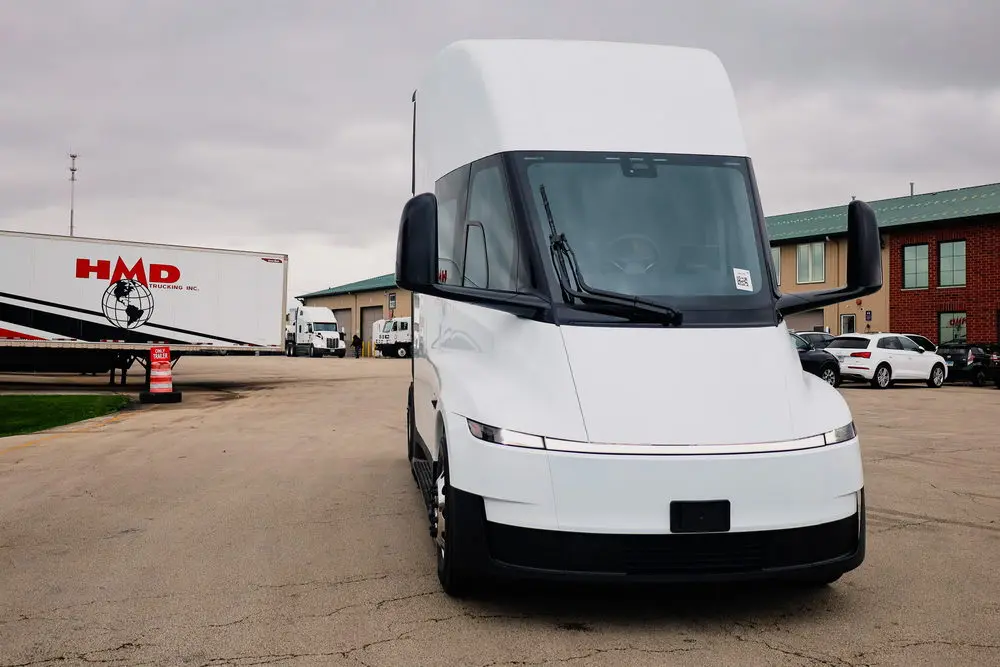
However, something new happened on November 2nd. Unit number one of our 50-truck Tesla Semi order entered the yard without exhaust smoke, vibration, or load roar: it made a quiet entrance with just a low hum and crunching on the pavement. Once all papers were signed officially, this electric truck became the first Tesla Semi registered in the state of Illinois.
People online have strong opinions about this. Post a photo of an electric Class 8 truck, and the comments split into two camps right away: one says diesel is dead, and the other says an electric truck couldn’t haul a feather to the end of the block. At HMD Trucking, we don’t buy into either extreme. We choose equipment based on spreadsheets, scale tickets, and mileage. This wasn’t an experiment or a marketing stunt. It was simply the logical next step. Here’s the real story of our 50 Tesla Semis: why we bought them, how they performed in this summer’s trial, and what might change for our drivers.
From Pilot Projects to Factory Floors
It’s always worth looking past the hype to find the real story.
Until recently, most news about the Tesla Semi centered on a handful of trials. The trucks mostly ran in sunny California, hauling light loads like soda or potato chips on easy roads. Those runs proved the truck could handle an 80,000-pound load, but they still involved prototypes built in a small workshop.
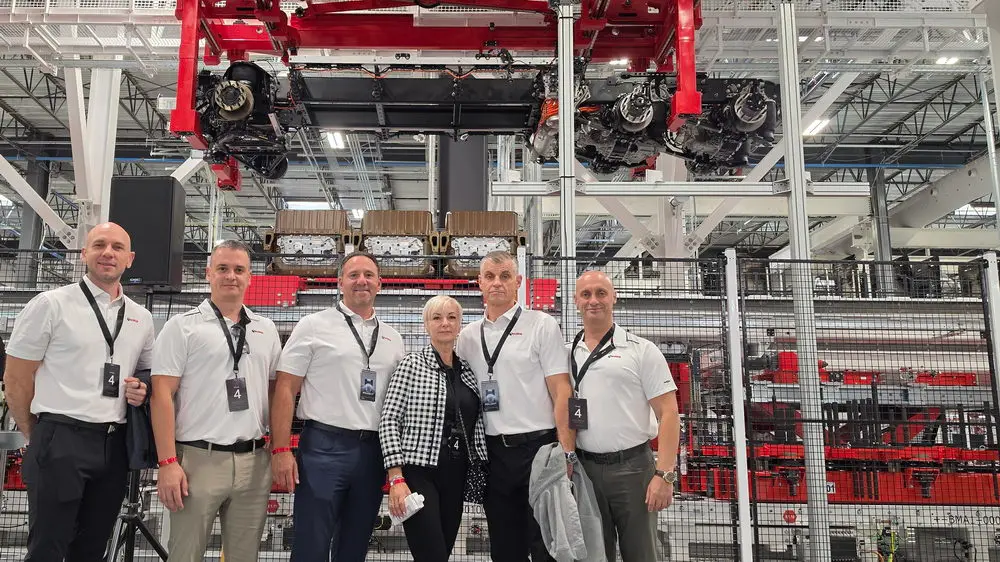
On September 24, this changed. We went to the rollout event where the launch of mass production of the Tesla Semi truck in the official factory in Sparks, Nevada, was announced. The factory covers 1.7 million square feet. More importantly, it is built to manufacture up to 50,000 electric trucks per year. Seeing such a huge factory in person, one can say that the era of small-scale garage construction is over and full factory production has started.
There were 11 customer liveries displayed in the factory on that day, but most of the companies participating were large, private fleets operating their captive distribution network. HMD Trucking stood out among all the participants – it is a commercial, asset-based motor carrier. We operate dry vans, flatbeds, HazMat, and doubles. We work with real shippers, unforgiving appointment windows, and the harsh reality of Midwest freight corridors.
Thus, when taking the delivery of our first truck from a 50-unit order, we can say that this technology is out of the greenhouse and now works directly in commercial freight service.
The 4,000 Miles Summer Trial: Proving the Numbers
But before purchasing 50 pieces of any equipment, we have to make sure of its abilities and possibilities in the practical environment. We cannot trust appearances when it comes to customer freight and drivers' paychecks. Therefore, we did a summer test drive of one Tesla Semi, covering 4,000 miles with our dry van semi-trailer, loaded up with cargo, and paying attention to real-life energy consumption.
The first result we were able to achieve was 1.74 kWh/mile. For those who are trying to save money on every mile driven, this number might seem quite impressive.
To illustrate how impressive it is for a real HMD lane, imagine a regular 400-mile regional day. If you use a diesel tractor at 6.5 mpg, the amount of fuel consumed is about 62 gallons, which costs around $387 in one day with an average price of $6.29 per gallon. Using the electric Tesla Semi at 1.74 kWh/mile would require 696 kWh in a 400-mile run, which, considering $0.35 per kWh for Megachargers, would cost about $244 a day. And charging at our depot with a price of $0.12 per kWh will reduce the costs even more – to $84.
Beyond the daily fuel math, let's spell out what this efficiency means in plain language:
High Efficiency: Diesel engine is a masterpiece of engineering, but even the most advanced diesel loses more than half of its energy potential through the radiator and exhaust heat. In the case of an electric motor, almost 90% of energy is transformed to the mechanical output, and an average of 1.74 kWh per mile for 4,000 miles proves that the rear axle electric motors and the aerodynamic shell of the truck work well in real-life conditions.
End of Idling: The long-haul diesel burns about a gallon of diesel per hour in order to maintain the proper cab temperature. In case of an electric powertrain, it uses only energy required by the climate control compressor, and there are no engine cycles to waste when the traffic on I-294 comes to a halt.
Absence of Aftertreatment: Today, most cases of unplanned stoppage of a diesel truck are caused by a clogged DPF, a faulty DEF sensor, or an SCR system throwing a phantom check engine code. An electric truck eliminates that system from the equation entirely.
As Michael Mahler, COO of HMD Trucking said:
"With nearly 15 years of experience with the amazing Tesla technology, we have a very clear understanding of what Tesla vehicles can do. Tesla has been transparent with us regarding the capabilities of Semi every step of the way, and it has not disappointed. We are beyond excited to be one of the first to show our customers and the public what can be accomplished with this technology and further strengthen our position as an industry leader."
Welcome to Chicago: Winter is Coming
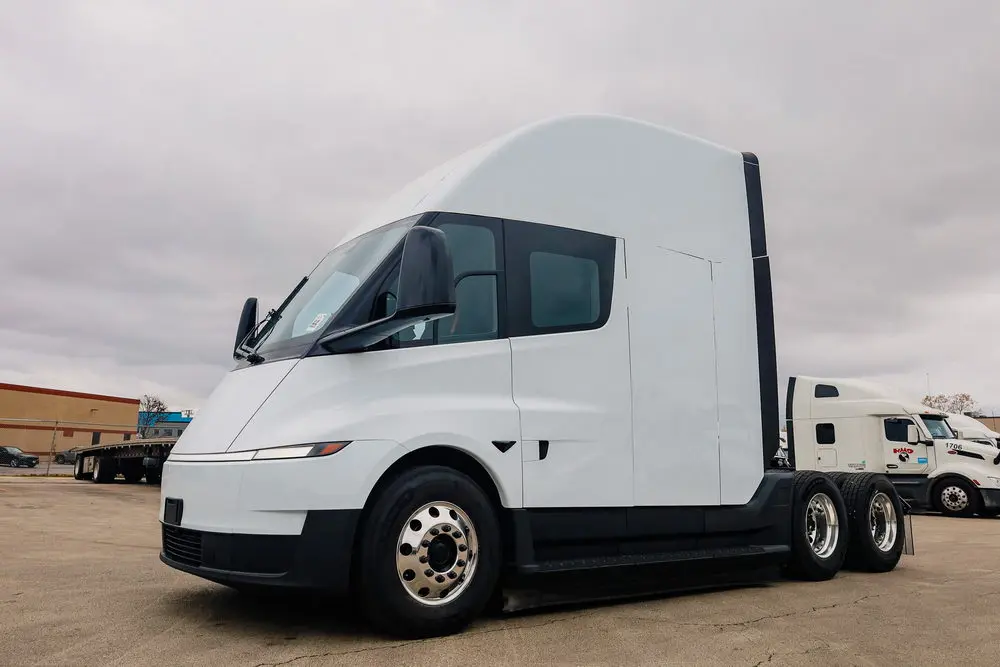
Unit number one, delivered on November 2, will not have time to relax, because we are going straight into the Great Lakes winter with it.
California sun is nice to have for brochure photos, but January in Chicago is the place where freight carrier reputations go to die. It means sub-zero temperatures, freezing rain covering windshields in seconds, lake-effect snow storms turning highways into parking lots, and salt water corroding the wiring harnesses on contact.
Being one of the very first carriers testing the Tesla Semi in winter, we want to collect this valuable data for future development.
Battery Conditioning in Extreme Cold: Cold lithium cells do not want to charge from a fast charger until their temperature reaches proper levels. We want to measure how much energy the battery pack thermal management system will use to maintain itself in the proper temperature range, staying outside in single-digit temperatures.
Cab Comfort Under Load: Using an electric heater to keep the driver warm in extremely cold weather takes power. We will track precisely the auxiliary energy consumption for the dispatchers to adjust the daily range radius in winter weather.
Regenerative Braking on Slick Roads: This is a big one for our safety team. Tesla Semi uses a regenerative braking system, which allows it to slow an 80,000-pound combination without pressing the brake pedal. The question is how this regen will be managed by an autonomous traction control system to keep the tractor tracking straight in case the road is covered in slick black ice.
Sending this truck out into the middle of Midwest winter weather conditions is the ultimate test for it. If it survives in Chicago in February, it will be able to withstand almost any other weather conditions in North America.
Zero Oil, Zero Filters: Changing Service Time Models
Ask anyone in trucking where the real money disappears, and the answer is rarely out on the open road. It is in the shop.
Class 8 diesel tractor-trailers are marvels of engineering but require constant maintenance. At every period of time, the tractor must go through preventive services – draining ten to twelve gallons of engine oil, changing fuel filters, oil filters, and coolant levels, and finding out why the check engine light turned on because of some sensor failure. More complicated repair jobs would include rebuilding the alternator, installing new starters, changing worn-out serpentine belts or water pumps, and fixing stubborn aftertreatment systems that do not want to clear their codes.
When a truck is parked over a pit waiting for oil changes, parts, or diagnostic scans, it isn’t generating revenue.
With the Tesla Semi, that routine maintenance mostly disappears.
First of all, since the driveline is electric, there is nothing to change – no engine oil, no fuel filters that could starve your engine, no glow plugs, and no exhaust aftertreatment system to diagnose or revive.
The brake pads and drums wear much slower thanks to the significant regenerative braking that would be performed by the drive motors, which will do most of the braking and recharge the battery pack.
Except for tire monitoring, washer fluid levels, air cabin filters, and greasing some joints, there would be almost zero costs of maintenance required. In terms of the fleet maintenance department, it means not only saving on fluids and parts but also having constantly available equipment, no breakdowns on highways and trucks driving where they should – delivering your freight.
Are We Switching to Electrics?
Whenever anyone asks about our 50-truck order, the first question is: "Are you getting rid of your diesels?" The short answer is no. Absolutely not.
Common sense has to prevail here. HMD Trucking currently operates over 650 trucks and employs more than 600 professional drivers. The trucks drive freight coast to coast, through the Rocky Mountains, across the Great Plains, and deep into the South. Diesel-powered trucks remain the kings of cross-country freight, and nothing can change this in the nearest future.
The reason is clear: national infrastructure. It is impossible to park an 80,000-pound combination truck in some rural truck stop in western Nebraska and see three high-megawatt chargers waiting for you. This grid, the electricity lines, and the chargers themselves are not there yet along the transcontinental corridors.
Our strategy is quite simple: use the right tool for the right job:
For dedicated regional runs: Tesla Semi perfectly fits this task. We will run our Tesla Semi trucks on predictable local loops out of our Chicago Ridge yard. They will leave in the morning, do their job within the Chicagoland metro area or nearby regional corridors, and return to the terminal during the off-peak hours, recharging there. With the growing public network of high-power chargers in Illinois and Indiana, we will be able to extend these runs.
For long-haul OTR freight: our diesel fleet continues transporting the heavy freight across the country. These trucks have 1,000 miles of range per tank, 5-minute fill-ups, and high reliability for nationwide supply chains.
Acquiring electric trucks is not an all-or-nothing competition. This is about matching the equipment to its optimal duty cycle.
Life Inside the Center Seat
You can talk about the fleet metrics as long as you want, but remember that trucks do not drive themselves. The person in the driver's seat decides the fate of this project.
Our experienced drivers note three things after spending some time inside the cab:
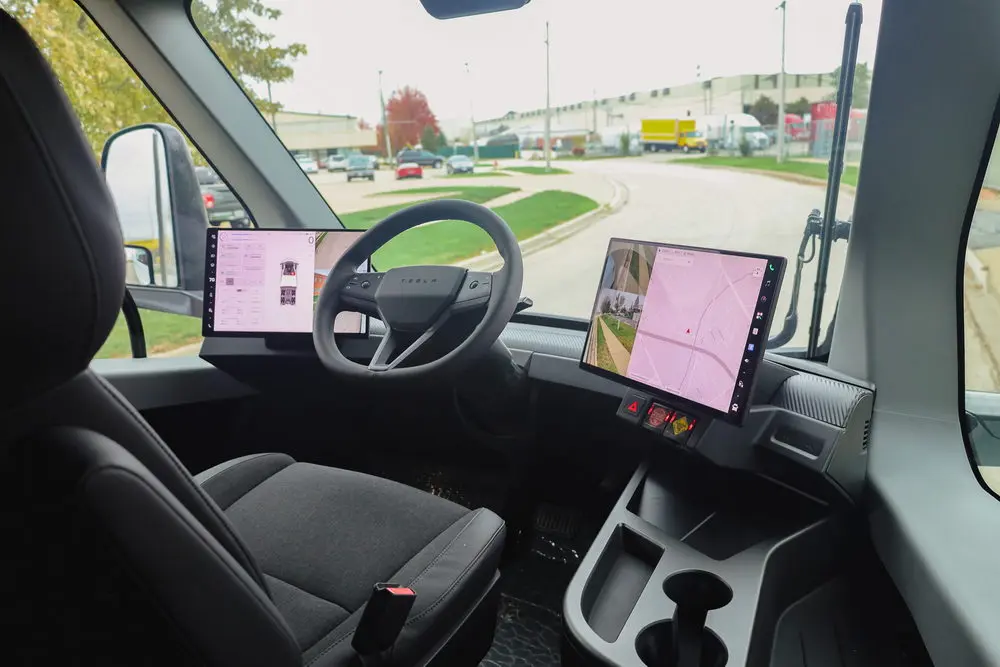
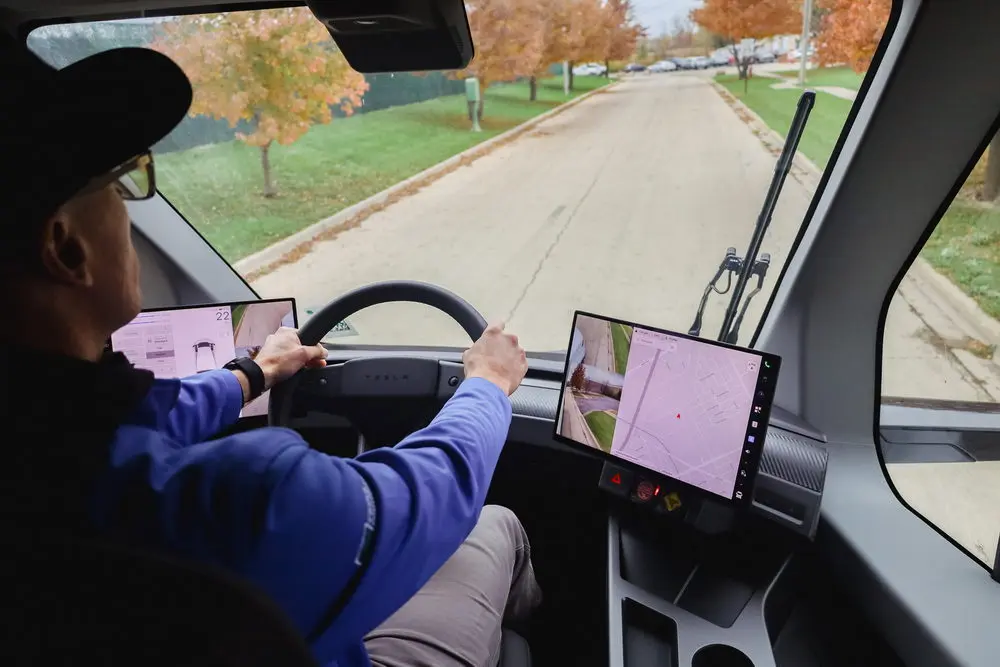
1. The center seat. At first, sitting at the very middle of the cab can feel quite weird. But once you get into your first tight turn into a jam-packed receivers' lot, you will realize that you have a real 180-degree vision through both sides of the wraparound windshield. There is no massive fiberglass hood, protruding ten feet forward and limiting your ground-level field of vision, obscuring small passenger vehicles right in front of your vehicle.
The aforementioned high visibility is supported by an extensive system of 10 exterior cameras positioned in all the strategic places around the tractor. When it comes to backing up into small docks, maneuvering through the narrowest alleyways, or watching the blind spots when changing lanes, you will have the live feeds from all the cameras displayed on your right-side screen.
Regardless of the massive number of cameras installed, Full Self-Driving (FSD) does not work at all on the Tesla Semi. There is no way of utilizing the FSD or even any other form of autonomous driving. Therefore, each and every mile is being navigated by a professional driver only. The cameras in this case are just used to provide a highly visible tool set to our drivers.
2. The silence. Any trucker knows that constant deep, low-frequency sound of the engine and driveline vibrations. After 10 hours behind the wheel, this sound and vibrations drain your energy, even if you sit in the cab. But in the electric truck, there is no such sound anymore. All you hear is wind, tire noise, and your music at the conversation volume. This reduction of physical fatigue is obvious.
3. The instant torque. Accelerating an 80,000-pound combination truck from a dead stop and merging to a busy interstate ramp usually requires several gear changes and waiting for the turbocharger spool. In an electric truck, this acceleration becomes instant and smooth, making your merging onto the busy highway less stressful and more comfortable.
Conclusion
HMD Trucking started our journey 28 years ago with one goal: deliver freight safely, treat people with respect, and do what you say you are going to do. We grew by paying attention to the road ahead, not just looking in the rearview mirror.
Taking the delivery of the first registered Tesla Semi in Illinois is a great achievement for our company, but it is the first step on the way to success. The other 49 units are coming. We are very excited to see how they perform, and we are ready to learn from the winter weather and share our results.