Practical AI in Trucking: Safety and Fleet Wins Without the Hype
by Michael Mahler — HMD Trucking
In recent years, trucking AI has evolved from the rousing promises of software vendors to focused applications that help carriers cut through bottlenecks on the road, in the dispatch room, and in the maintenance shop. At the September 2026 TMC AI Summit in Pittsburgh (AI Summit 2 in data-driven safety) and subsequent MCE panels (October 2026), key executives from carriers discussed what is working for them out on the road.
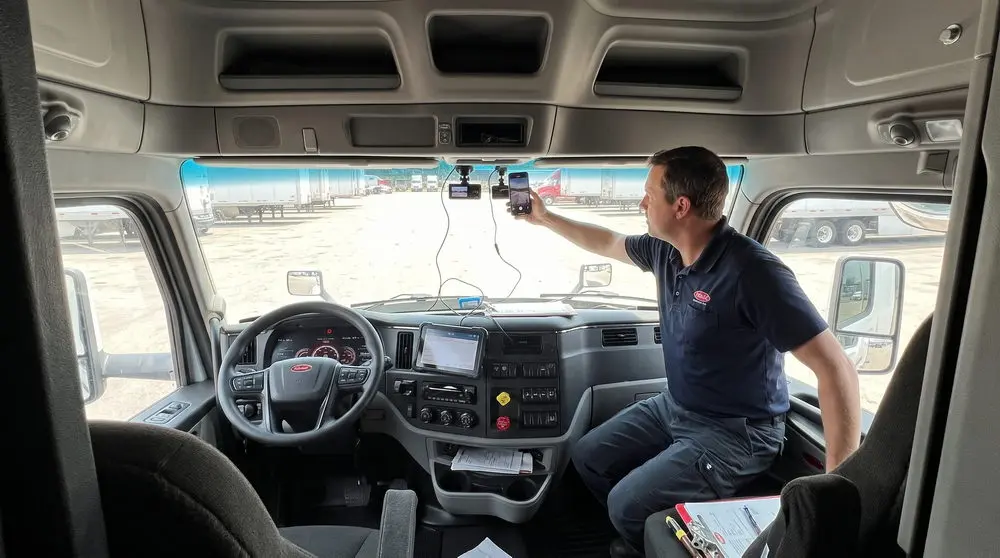
Art Vallely, president of Penske Truck Leasing, outlined the practical benchmark carriers should measure before implementing new software: Does the software keep equipment available, improve maintenance execution, and help people act faster? At HMD Trucking, we evaluate our fleet technologies on these terms. Systems that reduce crash risk, increase diagnoses in the shop, or lower schedule stress merit implementation, not systems that create legal liabilities and micromanage drivers.
Let’s take a look at how U.S. fleets are using AI today, what solutions are good only in theory, and how trucking can benefit from AI preserving the tight driver control over the essential parts of the job.
Ditching the Gotcha Culture in the Cab
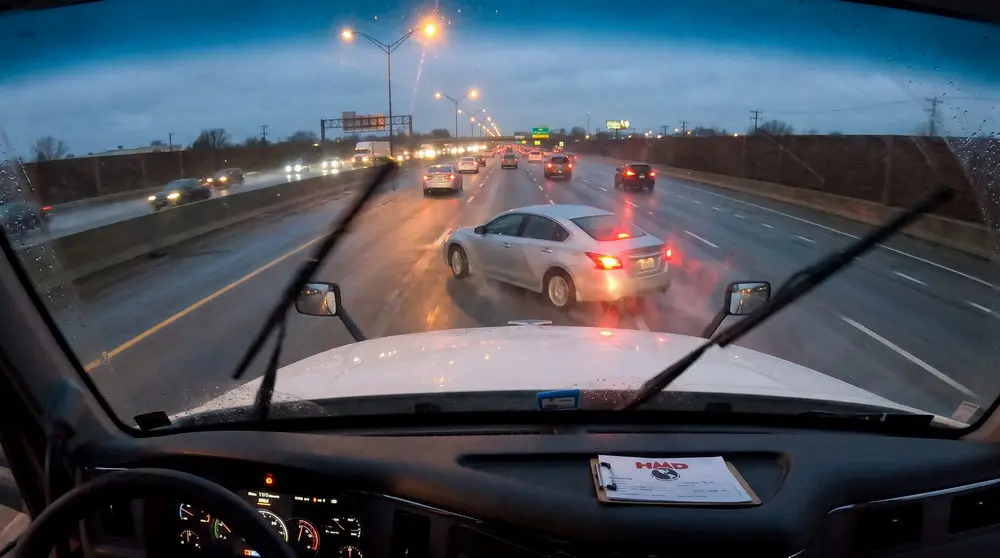
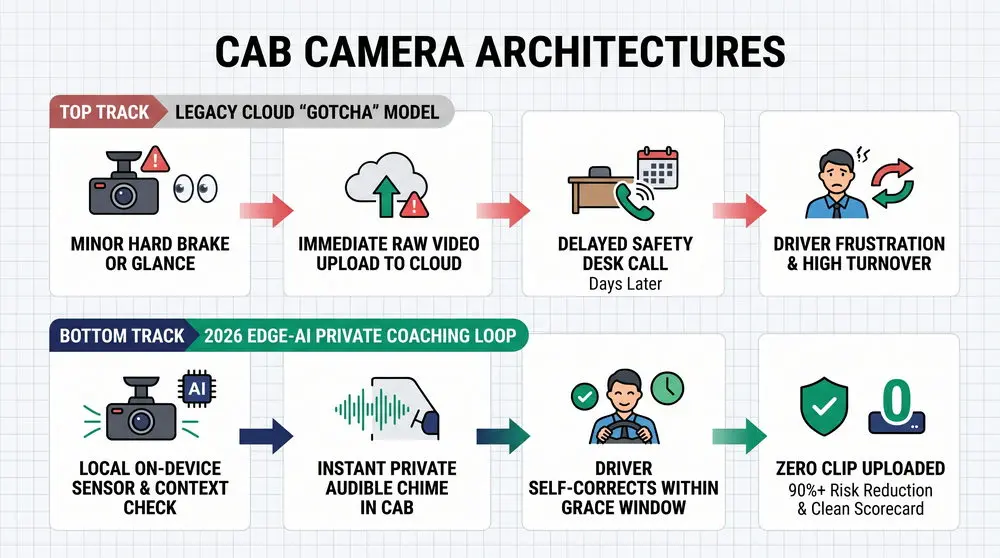
For many years, inward-facing cameras provoked instant rejection from professional drivers and, to be honest, it was easy to understand why. Earlier versions of camera platforms functioned as remote tattletales. One day the driver would run into a bad road segment or brake in heavy traffic, and the clip would be sent immediately to the company's safety desk. Later the driver would be called to discuss his actions in a traffic moment that he could not even remember anymore.
The major lesson from the AI Summit 2 is that edge computing destroys this punitive culture. Rather than sending all clips back to the company's headquarters, the modern smart cameras perform video analysis right in the hardware installed in the cab.
During the summit panel, Netradyne's CBO Adam Kahn noted that instant feedback in the cab is twice as efficient as post-drive coaching at the end of the day and ten times as efficient as one that is delivered a week later. Lytx Senior Product Manager Dan Lambert gave real-life evidence of this: as soon as they implemented instant notifications in the cab, more than 90% of flagged risky behaviors were eliminated.
This is why the new approach is gaining popularity among drivers:
Private self-correction: Regarding edge-AI-based notifications, such as the workflow introduced by Isaac Instruments in October 2026, the camera makes an audible chime whenever there is any distraction or following distance issue. If the driver reacts and eliminates this problem within a short grace window, no clip is recorded and sent to the company. As noted by the co-founder of Isaac Instruments J.S. Bouchard, it is completely useless for any carrier to have video recordings of a driver holding a phone stored on their server.
Providing context, not triggers: In the past, telematics flagged every hard brake as an act of reckless driving. Nowadays, camera systems use the combination of video feed and data collected by truck's telematics to determine whether the behavior is tailgating or defensive maneuvering to avoid collision with pedestrians.
Celebrating drivers: With the help of smart cameras that record thousands of safe miles monthly, carriers can now reward the best-performing drivers using scorecards like GreenZone introduced by Netradyne and Driver Rewards by Motive.
At the October 2026 MCE panels, fleet owners showed how generative video coaching is becoming scalable personal coaching as well. For example, Bennett Family of Cos. with their fleet of around 2,500 trucks and Halliburton have started using Motive's AI Coach to provide personalized safety videos to 100% of drivers. During MCE panel presentations with the participation of Werner Enterprises, FirstFleet, and Bennett, self-coaching reminders achieved the same-day driver viewership of 97%, while automatic violation triage cut safety review research time from 4 to 5 minutes to roughly 30 seconds.
What Real Fleets Are Actually Deploying Today
Talk is cheap at industry conferences, so it helps to look at what established carriers are actually running in daily operations. Across the 2026 AI Summit and MCE discussions, the strongest returns came from targeting narrow operational bottlenecks rather than trying to automate entire departments overnight.
Carrier or Fleet | Operational Profile | Practical AI Deployment | Measured or Reported Impact |
|---|---|---|---|
Bennett Family of Cos. | Flatbed carrier (~2,500 trucks) | Generative safety coaching videos | Scaled personalized coaching to 100% of drivers and strengthened crash defense |
Halliburton | Private oilfield fleet | AI video coaching with tracking dashboard | Delivered consistent fleetwide safety training and tracked viewership |
Modern Transportation | Bulk and specialty carrier | Precursor behavior monitoring | Shifted safety focus from post-crash review to live incident prevention |
Werner Enterprises | Major truckload carrier | AI freight appointment scheduling tool | Automates thousands of scheduling calls weekly for earlier dock times |
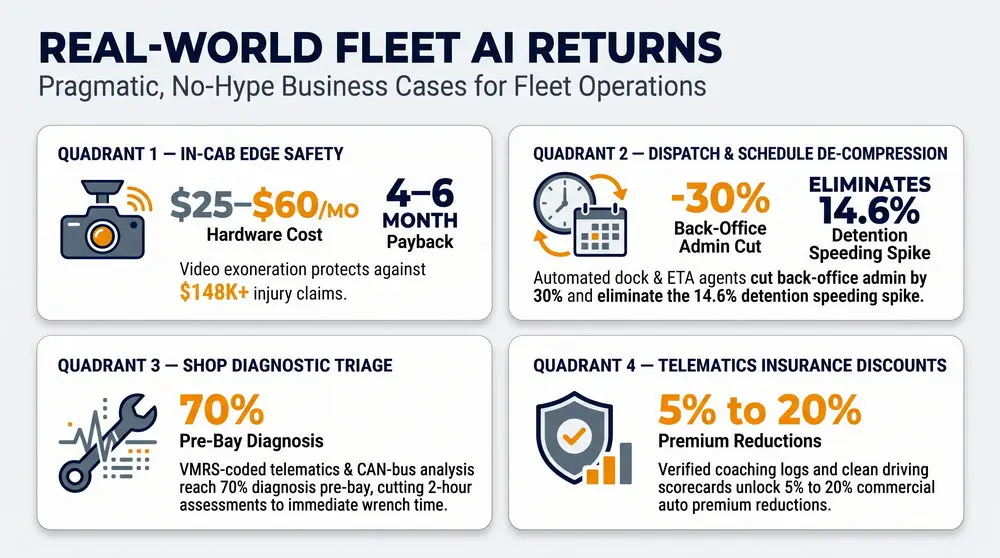
Grand Island Express | Refrigerated carrier | Automated order entry and ETA check-in agent | Saved back office staff 30% of their workday to support drivers directly |
Penske Transportation | Commercial leasing and logistics | Predictive fault alerts and fleet benchmarking | Notifies leasing clients before breakdowns and benchmarks fuel use |
Knight-Swift | Major truckload carrier | Parallel diagnostic triage workflow | Targets cutting two-hour shop assessments down to productive wrench time |
D.G. Coleman | Bulk and aggregate hauler | Natural-language fuel surcharge agent | Automated monthly rate updates and cut customer billing disputes |
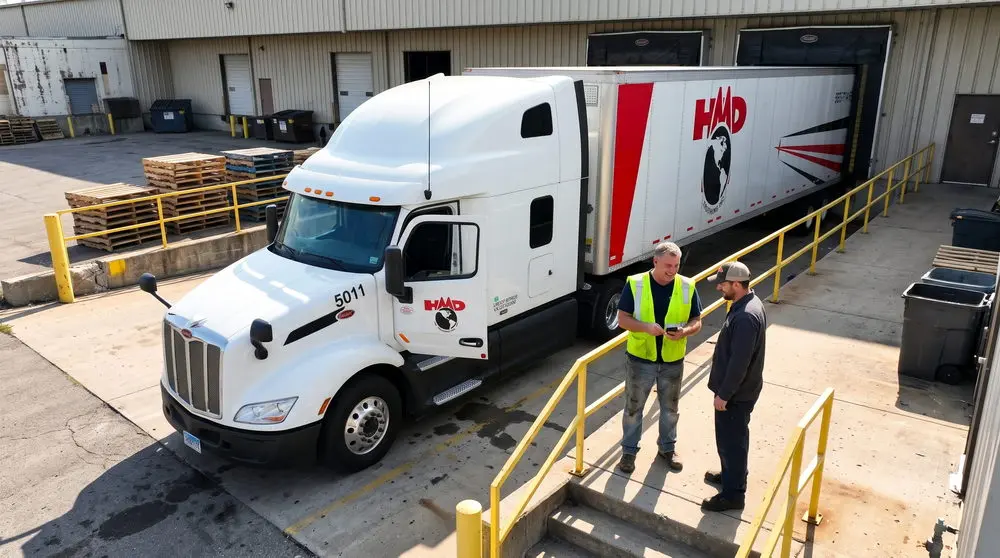
One of the smartest takeaways from AI Summit 2 was the link between safety risk and dispatch desk activity. Panelist Adam Kahn challenged fleet executives to locate the impacts of shipper loading delays on the highway. Research from the American Transportation Research Institute (ATRI) cited by PrePass Alliance shows that detained truckers drive 14.6% faster than drivers who are not detained because they are trying to recover lost Hours of Service.
When dispatchers make schedules shorter than necessary, drivers pay the price on the interstate. That is why carriers are investing in AI for their Transportation Management Systems (TMS) so they can fix schedule compression before a tractor ever leaves the yard. Werner Enterprises uses voice automation to book earlier dock times, and Grand Island Express uses an automated ETA agent to check on delayed loads so that dispatchers can focus on helping drivers. Platforms from Trimble, PCS Software, and BeyondTrucks now look up Hours of Service clocks, weather conditions, and equipment rules live before they even let unrealistic loads fall into a driver’s tablet.
Separating Real ROI from Vendor Sales Pitches
If you have ever sat through a software demo, you have likely heard inflated claims of 75% fewer crashes and 10X profits. Let's face it: all those numbers come from vendor studies of customers, rather than from independent multi-year audits.
To budget realistically, fleets need baseline numbers:
Monthly hardware costs: According to a study done by Oxmaint, the monthly cost for a mid-tier AI dashcam is about $25 to $35 per truck, while the price of a premium camera suite is $30 to $60 per month.
Payback period: Most carriers will see a return on investment within 4 to 6 months. Samsara promises that the accident frequency should begin to drop by the 3rd to 6th month after starting coaching.
Exoneration math: The average injury crash cost for trucks and buses in the U.S., according to FMCSA estimates, is $148,279, and the total amount of commercial auto nuclear verdicts in the U.S. is over $10 million. A single video exoneration from not-at-fault cars, like Rasmussen’s vendor-reported $1.2 million exoneration, can cover the cost of a subscription for an entire fleet.
However, the real-world hardware performance shows major differences between different vendors. In an independent, side-by-side test run by the Virginia Tech Transportation Institute (VTTI) and reported by Fleet Maintenance, Motive alerted on 77% of rolling stops compared to 0% for Samsara, while Lytx did not alert on rolling stops for its customers at all during the test. Close-following alerts fired on 67% of events for Motive, 28% for Lytx, and 18% for Samsara. Both Motive and Lytx caught 100% of seatbelt violations compared to 0% for Samsara. Lytx questioned the testing methods used by VTTI, and a fierce vendor battle even spilled into a $30.3 million arbitration settlement to Samsara over Motive's marketing claims disclosed in March 2026.
The lesson is clear: never buy cameras off a brochure. Run a 60-day side-by-side test on your own trucks and lanes to see which system catches real hazards without making your drivers crazy with false alarms.
Turning Clean Safety Data into Insurance Savings
The moment when AI safety programs can save customers some hard cash comes at the time to renew auto insurance. Traditional insurers used to shrug when carriers installed cameras and offered a tiny discount at best. But today, telematics-based insurers can easily tie premium auto insurance rates to verified driving information.
Upfront telematics discounts: Nirvana Insurance offers up to 20% off of your premium after 32 billion analyzed commercial miles. Plus, up to 25% off partner discounts on ELDs and dashcams.
Monthly dynamic pricing: HDVI’s Shift program offers mid-size fleets up to a 20% monthly dynamic discount based on driving habits, critical events, and route choices. HDVI caps premium rates so that they never exceed the policy base rate. And they don’t factor in video from inward cameras in the monthly discount calculations.
Renewal Discount: For the insurance industry as a whole, fleets who bring along documentation of coaching hours, declining alert rates, and exoneration videos to an insurance renewal typically receive 5-20% discounts.
As with all insurtech services, keep in mind that accounts on Nirvana tend to be capped at around 200 power units and restrict heavy haul, hazardous material above Class 3, household goods, auto transport, and towing. If your telematics data shows frequent speeding or unaddressed alerts, an AI-powered insurer may quote you more than a traditional underwriter. Clean driving gets rewarded, while sloppy driving will lead to financial losses.
Diagnosis Without Guesswork in the Shop
While safety cameras get most attention, maintenance directors at the September 2026 AI Summit were more impressed with what AI is doing in the shop. No one expects any software to work with wrenches, but diagnostic guesswork is one of the worst profit killers in trucking.
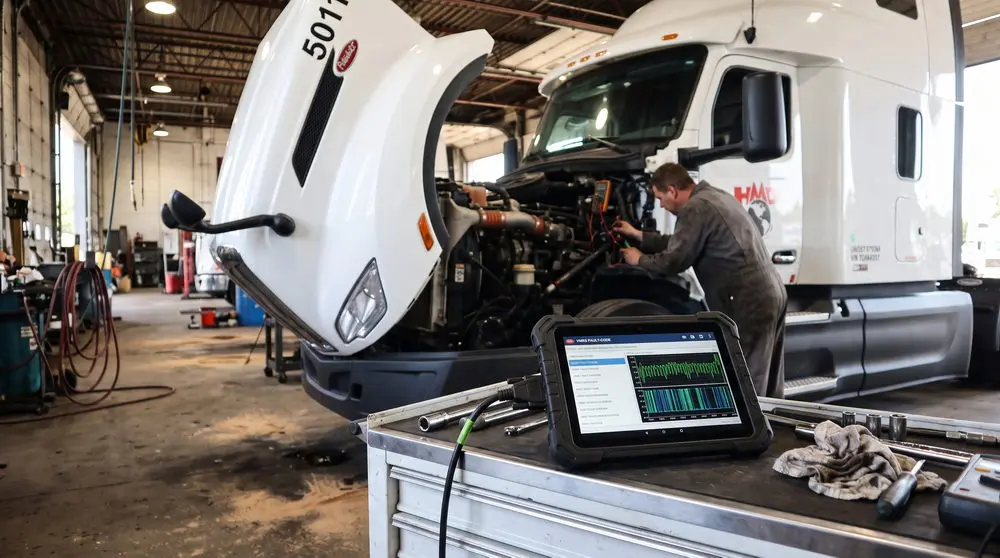
At AI Summit 6, Pedigree Technologies Vice President of Sales Rocco Marrari demonstrated how telematics platforms are now able to compare live blips from the sensors with the truck model and maintenance record to get technicians to 70% of correct diagnosis even before the truck enters the bay. TMC General Chairman and Knight-Swift Vice President of Equipment Mark Kennedy showed how the parallel AI diagnostic triage, taking into account fault codes, repair history, and service bulletins, aims to reduce two hours of the rapid assessment window according to TMC Recommended Practice 1604 down to immediate wrench time.
In the electrical troubleshooting, TMC S.12 Study Group showcased the AI tool that analyzes voltage fluctuations on the Controller Area Network (CAN) bus to identify intermittent faults before spending money on replacing good parts.
But there is a stern warning from the TMC maintenance leadership team: shop AI systems are totally useless without strict data discipline. If mechanics type vague freehand notes in repair orders, the predictive models choke on faulty input. Before purchasing any shop predictive AI tools, carriers have to implement VMRS (Vehicle Maintenance Reporting Standards), specifically TMC RP 802H, mapping VMRS codes to SAE fault codes. In addition, TMC executives Robert Braswell and Jack Legler remind fleets that the conventional computer simulations still beat AI solutions when it comes to truck specification across diverse duty cycles, and UPS's presentation on driver vehicle inspection reports emphasized once again that bad habits can’t be fixed with any technology.
In addition, shops have to update safety procedures along with the development of more advanced vehicles. In the July 2026 update of TMC Recommended Practice 543A Lockout/Tagout Procedures, it is stated that old key-in-pocket techniques are dangerous for electric, hybrid, natural gas, and ADAS tractors. Disconnecting batteries blindly can erase telematics data or recalibrate safety sensors that require structured power-down steps.
Privacy, Biometrics, and Owning Your Fleet Data
Without raising the topic of privacy and legal liability, there is no serious discussion on how AI is applied in the trucking industry. In Illinois, biometric privacy becomes an important compliance matter for every carrier providing Midwest freight transportation.
According to the Illinois Biometric Information Privacy Act (BIPA), any firm operating camera-equipped trucks across Illinois, irrespective of the carrier headquarters location, may become subject to class action lawsuits if the camera collects facial geometry without the published retention schedule and written consent from the driver. After the $228 million jury award against BNSF Railway for biometric gate scans, the class actions have been brought against both carriers and camera vendors, resulting in settlements up to several million dollars, such as $4.25 million for Lytx and Maverick Transportation and $132,300 for Lily Transportation. Although Illinois has updated BIPA making changes to cap the damages to one violation per individual and accept electronic consent signatures, lack of written consent when using the cameras is an avoidable mistake.
Data sovereignty is also essential. TMC representatives at the AI Summit advised carriers to examine vendor software contracts because providers should not be able to use operational data. Isaac Instruments CEO Jacques DeLarochelliere seconded this warning at the October 2026 event urging carriers to reserve ownership of data streams strictly to themselves. At the same time, fleet owners must support Right to Repair standards so OEMs cannot lock diagnostic codes behind proprietary walls.
Implementation Step | Practical Action for Carriers and Owner-Operators | Primary Operational Payoff |
|---|---|---|
1. Target One Bottleneck | Pick a specific pain point like detention, speeding, scheduling calls, or shop triage | Avoids wasted software spend on flashy features |
2. Clean Your Data First | Enforce VMRS coding (RP 802H) and connect TMS, ELD, and camera feeds | Prevents garbage outputs in predictive tools |
3. Enable Private Cab Alerts | Set edge-AI grace windows so drivers self-correct before clips upload | Cuts risky habits by over 90% without driver backlash |
4. Lock Down Consent & Contracts | Secure written BIPA consent and audit vendor data-sharing clauses | Eliminates biometric lawsuits and protects fleet data |
5. Run Side-by-Side Pilots | Test competing cameras on your own lanes for 60 days before buying | Filters false alarms and verifies real detection accuracy |
6. Monetize Clean Trends | Package coaching logs and exoneration clips for insurance renewals | Captures 5% to 20% discounts on commercial auto premiums |
Key Takeaways for Drivers and Fleet Managers
Edge alerts support driver independence: Quick feedback from the dashboard helps change bad driving behavior in private, without having to inundate the safety office with countless clips.
Optimizing schedules saves lives: Delayed drivers are 14.6% faster when trying to make up for time lost, making automatic scheduling an immediate improvement in highway safety.
Try the products yourself: Testing reveals vast disparities between brands when it comes to alert frequency, making side-by-side tests far more informative than vendor claims.
Shop AI requires VMRS compliance: Predictive diagnostics can reduce assessment delays, but only if repairmen use standardized VMRS codes when logging fixes.
Biometrics must comply with the law: Driver consent must be obtained in writing prior to using the inward-facing cameras on trucks travelling through Illinois.
Keeping Technology on the Side of the Driver
The truth is that no matter how much technology advances, the trucking industry remains fundamentally a business that relies on people and their judgment, skill, and grit on the open road. In reality, the takeaway from 2026 ATA TMC AI Summit is quite simple – artificial intelligence works best as an unseen tool, eliminating clerical work at dispatch desks, speeding up fault detection for mechanics, and alerting the driver of a potential hazard.
HMD Trucking buys state-of-the-art equipment and smart technologies because our drivers deserve tools that protect their safety, respect their professionalism, and keep their wheels turning without unnecessary headaches. When technology serves the driver instead of policing them, everybody gets home safely.