EPA 2027: Key Hardware Changes in Heavy-Duty Diesel Engines
by Michael Mahler — HMD Trucking
Anyone who has spent some time roaming around the yard of our Chicago terminal knows that truckers enjoy discussing iron. We talk about horsepower, torque curves, fuel economy, and how well a vehicle is hauling an 80,000-pound load up the hill. However, recently when drivers, owner-operators, and fleet managers sit down for a cup of coffee, everyone keeps coming back to one and only date – 2027.
We experience a major regulatory shift once in every ten years or so, and we see how this shift completely redesigns the mechanical structure of commercial vehicles. This happened to us in 2007 when the Diesel Particulate Filters (DPFs) were introduced as a standard and in 2010 with the implementation of Selective Catalytic Reduction (SCR) and Diesel Exhaust Fluid (DEF). Now the Environmental Protection Agency is implementing its most ambitious overhaul in heavy-duty engine standards in over 15 years – the EPA 2027 Heavy-Duty Engine and Vehicle Standards.
Whether you operate one tractor as an independent owner operator or you help manage dozens of power units like we do at HMD Trucking, there is no way you should delay till late 2026 trying to figure out what is coming your way. With the federal rollout of EPA 2027 and state-level rules like the clean fleets regulation and evolving clean truck regulation standards across the country, diesel engines are facing a technical revolution.
It is time for a look under the hood to find out the core mechanical and electrical changes coming to commercial diesel engines and how it will impact your operations.
The Mandate in Plain English: What EPA 2027 Actually Demands
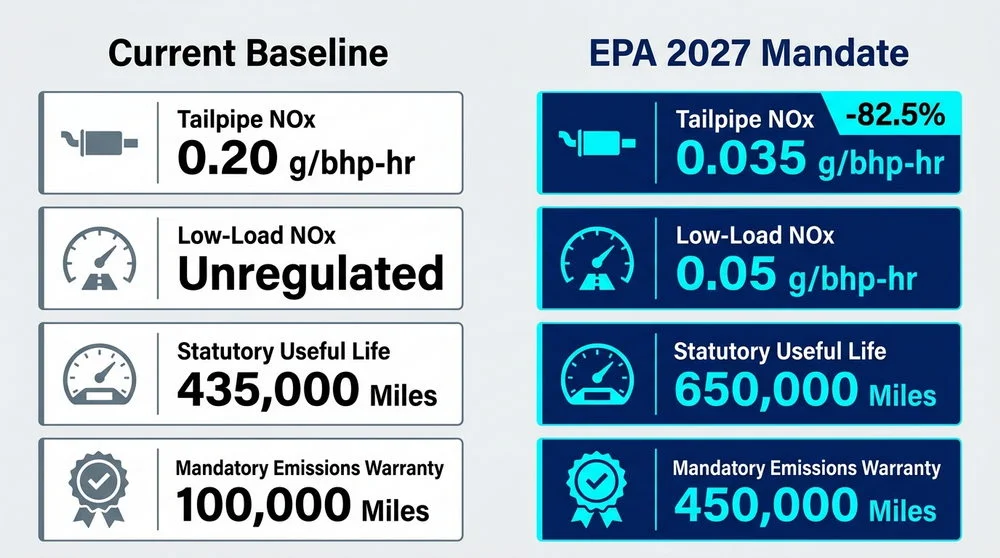
In order to comprehend why trucks need to undergo complete redesigning of the engine blocks and exhaust systems, it is necessary to analyze numbers. The first key point of the EPA 2027 mandate is an 82.5% cut of the allowable emissions of nitrogen oxides (NOx) as compared to the existing standards.
The current permissible amount of NOx emissions of heavy-duty diesel engines is 0.20 g/bhp-hr (grams per brake horsepower-hour). According to EPA 2027, starting with the model year 2027, it will drop to 0.035 g/bhp-hr of NOx under normal highway conditions. However, this is just half the story.
Regulatory Metric | Current Baseline Standard | EPA 2027 Mandate |
|---|---|---|
Normal Cycle Tailpipe NOx Limit | 0.20 g/bhp-hr | 0.035 g/bhp-hr |
Low-Load Cycle Tailpipe NOx Limit | Unregulated | 0.05 g/bhp-hr |
Extended Idle Tailpipe NOx Limit | Uncapped / Flow-Dependent | 10.0 g/hr |
Statutory Useful Life Definition | 435,000 Miles | 650,000 Miles |
Mandatory Emissions Warranty | 100,000 Miles | 450,000 Miles |
Previously, the major attention of emissions tests was paid to open-highway cruising, where exhaust gases are usually hot. With the advent of EPA 2027, the regulators are going to hold engine manufacturers responsible for the work of engines in realistic driving conditions. This means that there is a new stringent low-load cycle limit of 0.05 g/bhp-hr and an idle-state limit of 10.0 g/hr.
And why is it important for everyday drivers? Because standard SCR catalysts require temperatures between 200°C and 250°C to effectively turn NOx into harmless nitrogen gas (N₂) and water vapor (H₂O). When driving in the traffic in Chicago on I-90, while idling at the dock of a shipper or driving slowly during yard maneuvers, the temperature of the exhaust gases quickly drops. It causes the catalyst to cool and stop performing its function effectively. And under the new clean truck regulation framework, such a thing is not allowed anymore.
In addition to the aforementioned tailpipe caps, there is an increase in the statutory definition of an engine's “useful life” from 435,000 miles to 650,000 miles. Moreover, the required emissions warranty period will become 450,000 miles instead of the previous 100,000 miles. It means that the regulators are going to make sure that all trucks will stay clean for many years, transferring the long-term maintenance responsibility back onto the manufacturers.
Under the Hood: The 3 Big Hardware Transformations
Engine makers like Cummins, Detroit Diesel, PACCAR, and Volvo/Mack cannot simply slap a bigger filter on today’s engines to meet these targets. They have spent years re-engineering heavy-duty powertrains from the oil pan up. When you open the hood of a 2027 model-year tractor, here are the three major hardware systems you will find.
Hardware Subsystem | How the Technology Works | Primary Operational Benefit |
|---|---|---|
Dynamic Cylinder Deactivation (CDA) | Hydraulically disables cylinders during light-load operation | Keeps exhaust hot during low loads without burning extra diesel fuel |
Close-Coupled Dual-Stage SCR | Adds an upstream catalyst directly at the turbocharger outlet | Delivers rapid NOx reduction within seconds of cold ignition |
48-Volt Active Electric Heating | Dedicated 48V alternator powers an exhaust grid heater | Maintains catalytic temperature during extended idling & creeping |
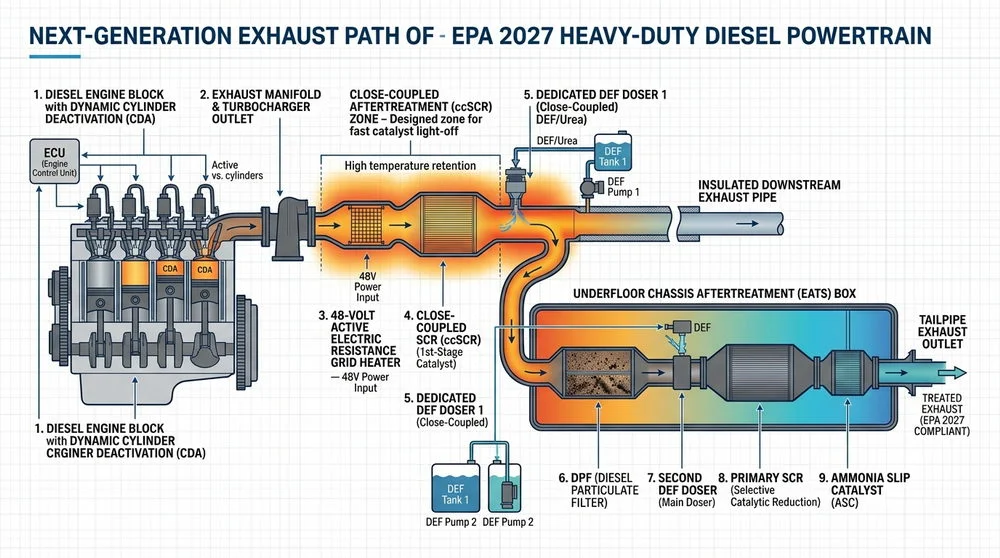
1. Dynamic Cylinder Deactivation (CDA)
Cylinder deactivation has been around for many years, being used in trucks and SUVs for reducing fuel consumption during highway drives. But in heavy-duty diesel engines, Dynamic Cylinder Deactivation has a totally different, important function: exhaust heat management.
When the engine of a 2027 truck is idle, or when a driver drives an unloaded truck or drives slowly downhill, the electronic control module and hydraulic actuators collapse the valve lifters on some cylinders (in most cases three cylinders out of six) while cutting off their fuel supply.
As a result, two effects are immediately seen:
Increased Load on Active Cylinders: Now the three remaining cylinders should do all the job, and as a result, the combustion temperature in them increases, keeping the exhaust piping hot.
Restriction of Mass Airflow: Inactive cylinders behave like closed air pumps and do not push fresh cold air into the engine, ensuring no cold outside air cools down the exhaust treatment catalyst.
CDA ensures that exhaust temperatures remain well above the critical level of 200°C and eliminates any need for late in-cylinder fuel injections to protect the catalyst and save fuel.
2. Close-Coupled Dual-Stage SCR Systems
Look at the chassis of a modern class 8 tractor and you will see how the entire aftertreatment system is enclosed in a large box-like assembly along the frame rail. However, there is a problem associated with this solution – distance. By the time the exhaust gases reach the frame rail from the turbocharger, they are already cooled down.
To solve the cold-start emission spikes, 2027-compliant engines use a dual-stage and dual-dosing SCR system:
The first stage is close-coupled SCR, which consists of a small SCR catalyst and dedicated DEF doser. Being located just after the turbocharger turbine housing, it is very close to the engine and receives its immediate heat, so it reaches operational temperature almost immediately after ignition.
The second stage is the underfloor unit, the primary downstream underfloor SCR, which comes into play on the highway when the volume of exhaust gases increases, cleans peak exhaust flows, and removes secondary ammonia slip.
Using two SCR catalysts, you have two dosing points and a more complicated system of sensors, but this way you ensure that the exhaust gasses get treated at each stage of your trip.
3. 48-Volt Electrical Subsystems & Exhaust Resistance Heaters
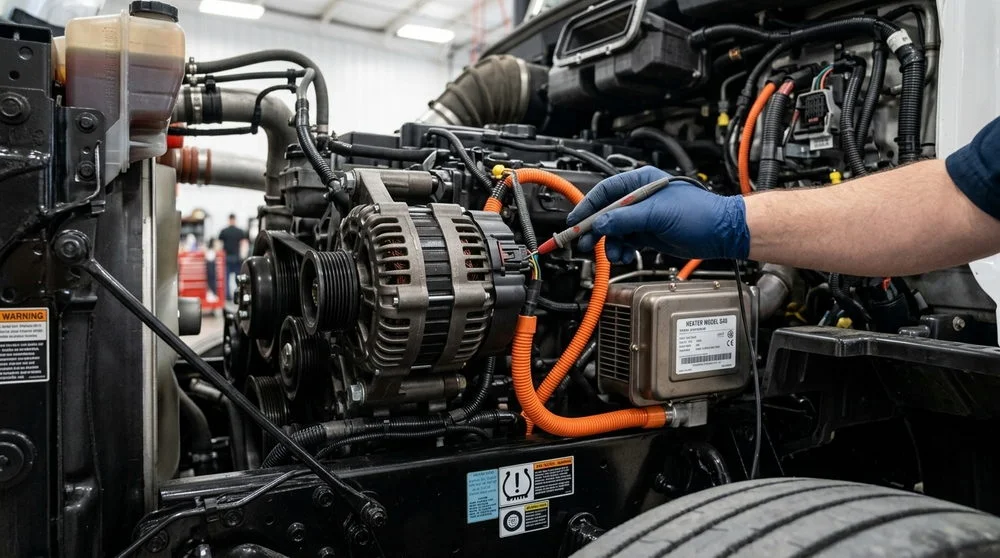
Every person who ever worked with commercial trucks knows about the standard 12-volt direct current electrical system of a truck. However, satisfying the low-load requirements of the new clean truck regulation implies active electrical heating of the system, which cannot be done with the help of a 12V system.
To solve this problem, several major engines, including Cummins X10, Detroit DD13/DD15 Gen 6, and PACCAR MX-13 engines, are using supplementary 48-volt electrical architecture.
Powered by high-output 48V alternators, these systems leverage electric resistance heaters, which are placed into the exhaust gases' flow just before the close-coupled catalyst. In case of starting the engine in freezing Midwestern winters or long idling, the 48V heater gets switched on, warming up the gases coming to the catalyst.
This solution eliminates hydrocarbon dosers diluting fuel in the system but adds high-voltage alternators, special DC-DC converters, and thicker electrical wires to the truck’s engine bay.
Equipment Economics: Sticker Prices, Warranties, and the Pre-Buy Surge
However, this high level of engineering technology has its price, and adding 48-volt electronic systems, two SCR canisters, dynamic valvetrains, and sensors increases production costs.
According to industry experts, 2027 model year Class 8 tractors are expected to carry a purchase price premium of $8,000 to $25,000+, depending on the type of vehicle, with an average increase ranging between $15,000 and $20,000 for mainstream line-haul tractors. In the case of a financed vehicle, this results in $390 to $500 additional cost per month, which affects total operating expenses.
Commercial Ownership Factor | Pre-2027 Baseline Standard | EPA 2027 Outlook |
|---|---|---|
Average Tractor Price Premium | Baseline Market Pricing | +$8,000 to +$25,000+ |
Monthly Financing Impact | Standard Note Amortization | +$390 to +$500 per Month |
Factory Emissions Warranty | 5 Years / 100,000 Miles | Up to 10 Yrs / 450,000 Mi |
First-Year Fuel Economy Shift | Baseline Miles Per Gallon | -1% to -3% Thermal Drag |
Used Pre-2027 Equipment Demand | Standard Depreciation Rate | Elevated Value Retention |
Why the 450,000-Mile Warranty Matters
One of the frequently asked questions is why the trucks are so expensive and whether it is actually the hardware components that are so costly.
Surprisingly, the hardware is just a small part of the cost issue. The main reason is the mandatory 450,000-mile emissions warranty.
According to the previous regulations and 100,000-mile warranties, in case of the catalyst or sensor failure at 250,000 miles, the owner paid for repairs. However, EPA 2027 regulations require that OEMs warrant these failures for almost half a million miles.
In order to compensate for future warranty repairs, OEMs include this potential cost of long-term component risk in the initial price. In other words, when buying this truck, you pay for the maintenance for years ahead.
Pre-Buying Market Realities
As a result of the price increase and the introduction of unproven first-generation hardware, truck owners and motor carriers are hurrying to execute equipment pre-buys.
Major companies and leasing firms fill order books for model-year 2025 and 2026 units to secure reliable, familiar engine designs and bypass initial sticker price surges.
The pre-buying market has led to increased allocations for 2025 and 2026 models and impacted the seller's market for late-model used trucks. Currently, 2024-2026 model year tractors keep their value, just like it happened during the 2007 and 2010 emission regulation changes.
Operating in the Real World: Shop Prep, Telematics, and Fuel Economy
Transitioning your fleet to comply with clean fleets regulation mandates and new engine standards involves more than just ordering new trucks – it requires rethinking daily maintenance and shop operations.
Strategic Preparation Area | Actionable Step for Fleets and Owner-Operators |
|---|---|
Diagnostic Tooling & Shop Safety | Upgrade shop meters and train techs on 48V DC circuits |
Predictive Maintenance Telematics | Deploy high-frequency sensor monitoring for 94% accuracy |
Warranty Claims Administration | Establish direct electronic claims filing with OEMs |
Driver & Fuel Optimization | Combine idle-reduction habits with aerodynamic upgrades |
1. Shop Tooling and Technician Safety
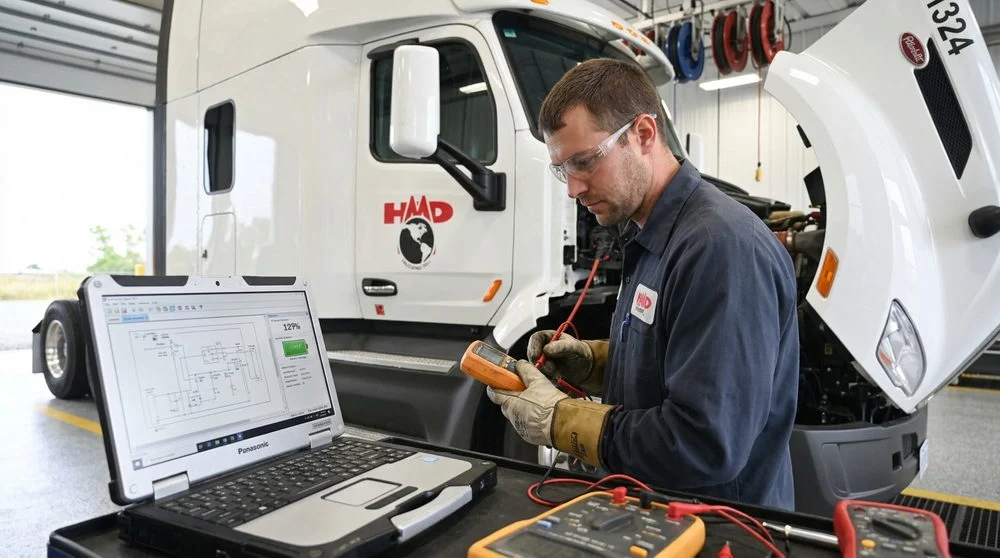
If your shop mechanics are accustomed to working exclusively with 12-volt electrical systems, 2027 hardware represents a steep learning curve. 48-volt subsystems carry distinct electrical safety requirements, specialized multi-meters, and unique insulated diagnostic tooling. Fleets that handle their own maintenance must invest in technician training well ahead of delivery day.
2. Leveraging Predictive Maintenance
With average Class 8 maintenance expenses climbing 8% to 12% across the industry to roughly $18,500 annually per truck, preventing roadside breakdowns is critical.
Modern fleet management tools are changing this equation. Advanced telematics systems now track engine vibration profiles, thermal curves, and backpressures to predict component failures with up to 94% accuracy.
Catching a drifting NOx sensor or failing heating grid before it throws a hard derate code saves thousands of dollars in emergency roadside service fees and keeps loads moving on schedule.
3. Managing the Fuel Economy Equation
Early engineering models suggest that first-generation 2027 engines could experience a 1% to 3% fuel economy penalty. The parasitic power needed to drive 48-volt alternators and keep active resistance heaters running consumes energy.
Carriers can easily offset this thermal penalty by pairing new equipment with proven operational practices:
Aerodynamic Upgrades: Adding trailer skirts, drive-wheel fairings, and roof deflectors can improve overall fuel economy by 0.5 to 1.2 MPG, saving between $2,400 and $3,200 per truck annually.
Auxiliary Power Units (APUs): Utilizing electric or diesel APUs for cab comfort reduces engine idle time, protecting sensitive 2027 aftertreatment components from excessive soot accumulation while saving diesel.
What This Means for Drivers and Small Fleets
The EPA 2027 timeline is firm: The EPA has confirmed that the 2027 start date and the 82.5% NOx reduction target will move forward as planned.
Engines are gaining advanced hardware: Expect to see dynamic cylinder deactivation, dual SCR canisters, close-coupled DEF dosers, and 48-volt electrical grid heaters on new power units.
New trucks will cost more up front: Average purchase price increases will range from $8,000 to $25,000+, driven largely by the mandatory 450,000-mile emissions warranty.
Pre-2027 iron retains strong value: Clean 2024–2026 used tractors are expected to hold strong market value as carriers look for dependable alternatives.
Smart maintenance makes all the difference: Staying competitive under both federal standards and state clean-fleet regulation programs requires predictive telematics, well-trained technicians, and disciplined fuel management.
Moving Forward with Confidence
The move to EPA 2027 is an event that will significantly affect the trucking industry in America, adding more mechanical intricacy, influencing warranty provisions, and implying actual financial costs. But being a flexible environment, the trucking sector has always adapted to regulatory changes, developing in the process.
At HMD Trucking, we understand that being informed helps protect your business and career as a driver. You can take advantage of the disruption by being aware of the upcoming clean truck regulation standards, planning equipment procurement, and using advanced predictive maintenance techniques to stay on top of your game.
If you’d like to drive state-of-the-art, late-model trucks with consistent miles and industry-leading pay, check out our available job positions for drivers with HMD Trucking!